 Tools
Tools
 Management of Antithrombotics for Gastrointestinal Procedures
Introduction
Antithrombotic therapy, including antiplatelet and anticoagulant agents, is used to reduce the risk of thromboembolic episodes in patients with medical conditions such as coronary artery disease, stroke, peripheral arterial disease, atrial fibrillation, venous thromboembolism, hypercoagulable states, and mechanical heart valves. Antithrombotic agents increase the bleeding risk when endoscopic procedures are performed; however, withholding these agents also increases the risk of thromboembolic sequelae. The optimal strategy for managing antithrombotic therapy when patients require gastrointestinal endoscopic procedures has been controversial. This chapter discusses antithrombotic therapy management based on the available evidence and current guideline recommendations.[1][2][3][4] The 2 critical factors to consider when performing an endoscopic procedure in a patient taking these agents are the risk of procedure-related bleeding and the risk of thromboembolism associated with the underlying medical condition for which the agents are prescribed.
Function
Register For Free And Read The Full Article
 Search engine and full access to all medical articles
- 10 free questions in your specialty
- Free CME/CE Activities
- Free daily question in your email
- Save favorite articles to your dashboard
- Emails offering discounts
Learn more about a Subscription to StatPearls Point-of-Care
Function
Bleeding Risk Associated with the Procedure
Various endoscopic procedures have different risks of associated bleeding.[2] Most data come from studies conducted in patients not receiving multiple antithrombotic agents; therefore, clinicians should interpret these risks with caution when applied to individual patients. Traditionally, endoscopic procedures associated with interventions have a higher bleeding risk than those without interventions. Other factors also influence this risk. For example, polypectomy, one of the most common interventions during endoscopy, carries a bleeding risk ranging from 0.3% to 10%, depending on polyp size, location, and type, as well as the resection or cautery technique used. Endoscopic submucosal dissection and endoscopic resection of large polyps (greater than 2 cm) are considered very high-risk procedures.[3]
Procedures with Lower Risk of Bleeding
- Diagnostic endoscopic procedures with or without biopsies
- Argon plasma coagulation
- Dilation of strictures
- Percutaneous endoscopic gastrostomy tube placement in patients on single antiplatelet therapy
- Biliary or pancreatic stenting
- Double-balloon enteroscopy without therapeutic intervention
- Esophageal, small bowel, or colonic stenting
- Endoscopic ultrasonography without tissue sampling or other interventions
- Radiofrequency ablation of Barrett esophagus
- Capsule endoscopy [2][5]
Procedures with Higher Risk of Bleeding
- Polypectomy
- Endoscopic interventions for bleeding
- Balloon-assisted enteroscopy for intervention
- Endoscopic mucosal resection or endoscopic submucosal dissection
- Endoscopic retrograde cholangiopancreatography with sphincterotomy
- Endoscopic ampullectomy
- Treatment of esophageal varices
- Percutaneous endoscopic jejunostomy tube placement
- Endoscopic ultrasonography with tissue sampling, cystogastrostomy, or other interventions
- Radiofrequency ablation of the esophagus or stomach
Thrombosis Risk Associated with Various Underlying Conditions
The underlying condition dictates the risk of thromboembolic episodes in these patients, especially when withholding the antithrombotic agent. Stroke prevention in nonvalvular atrial fibrillation is a very common indication for antiplatelet or anticoagulant therapy, and the risk of cerebral thromboembolism in these patients is predictable using the CHA2DS2-VASc index.[6][7] The score is used to determine whether the thrombosis risk is high enough to warrant preventive anticoagulant therapy. See Table 1 for the CHA2DS2-VASc scoring. In patients with coronary artery disease receiving antiplatelet therapy, a few important factors determine the risk of major adverse cardiac events. Placement of a drug-eluting coronary stent in the previous 12 months, placement of a bare-metal stent within 1 month, or occurrence of an acute coronary syndrome within 6 months is considered a high-risk condition requiring dual antiplatelet therapy. Patients receiving anticoagulation for venous thromboembolism or mechanical heart valves have different risk factors for thromboembolic episodes (see Image. Thromboembolic Episode Risks). The table shows that the patients were categorized into low-, medium-, and high-risk groups. See Table 2. [8] Coronary artery disease with stent placement is high-risk, while low-risk underlying conditions include ischemic heart disease without stent placement, previous placement of a bioprosthetic heart valve, peripheral vascular disease, and cerebrovascular disease. The implications of the CHA2DS2-VASc Score on antithrombotic therapy are discussed in the Clinical Significance section below.
Table 1. CHA2DS2-VASc Score for Thromboembolic Stroke Risk in Nonvalvular Atrial Fibrillation
| Risk factor | Score in points |
| C: Congestive heart failure | 1 |
| H: Hypertension | 1 |
| A2: Age 75 years or older | 2 |
| D: Diabetes mellitus | 1 |
| S2: Stroke or transient ischemic attack | 2 |
| V: Vascular disease (prior myocardial infarction or peripheral arterial disease | 1 |
| A: Ages 65 to 74 years | 2 |
| Sc: Female sex | 1 |
| Maximum score |
9 |
Table 2. Anticoagulation Recommendations Based on Total CHA2DS2-VASc Score
|
Total CHA2DS2-VASc Score (Men) |
Total CHA2DS2-VASc Score (Women) | Generalized stroke risk | Anticoagulation recommendation |
| 0 | 0 | Low | No anticoagulant indicated |
| 1 | 2 | Moderate | Anticoagulant use should be considered based on risk and benefit |
| ≥ 2 | ≥ 3 | High | An oral anticoagulant is recommended |
Clinical Significance
Interruption of Antithrombotic Therapy Before Endoscopy
Elective endoscopy: If the indication for antithrombotic therapy is short-term, elective procedures are best delayed until after that period. For patients receiving long-term or lifelong antithrombotic treatment, the decision to temporarily hold treatment for endoscopy should be made after discussion with the patient, the primary care clinician, and relevant specialists (eg, cardiologist, neurologist, hematologist, and gastroenterologist). In some high-risk patients, these agents cannot be interrupted, so the clinician and patient must weigh the risks and benefits of the procedure.
Parenteral anticoagulants (unfractionated heparin and low-molecular-weight heparin): Unfractionated heparin administered by continuous intravenous infusion can be discontinued 3 to 4 hours before endoscopic procedures, given its short half-life. Low-molecular-weight heparin (LMWH), including enoxaparin and dalteparin, should be discontinued 24 hours before the procedure, or longer if the procedure has a high risk of bleeding or if the patient has renal insufficiency. If the procedure is a diagnostic upper gastrointestinal tract endoscopy and biopsies are not planned, enoxaparin can be given the evening before the procedure, then restarted after the endoscopy.[9][10] Fondaparinux is a synthetic factor Xa inhibitor that requires discontinuation at least 36 hours preceding a high-risk procedure.
Warfarin: The therapeutic effect of warfarin is measured in terms of the international normalized ratio (INR). The INR decreases to less than 1.5 in more than 90% of patients when treatment is held for 5 days.[11] The overall risk of a thromboembolic event when warfarin is discontinued for 4 to 7 days is around 1%.[12] Therefore, some authorities recommend restarting warfarin within 4 to 7 days after initial discontinuation to minimize the risk of these events.[2] The American College of Gastroenterology and Canadian Association of Gastroenterology guidelines, however, recommend continuing warfarin in the elective setting.[2] The role of bridging therapy with unfractionated heparin or low-molecular-weight heparin in patients receiving warfarin across various indications has been studied. Based on current guidelines for patients with valvular atrial fibrillation receiving warfarin, bridging therapy is recommended for a CHA2DS2-VASc score of 2 or higher. LMWH should be started 2 days after discontinuation of warfarin therapy, and the last dose should be administered at least 24 hours before the procedure.[9] Patients with a CHA2DS2-VASc score of 0 or 1 do not require bridging therapy while withholding warfarin. Results from another study showed that bridging therapy for nonvalvular atrial fibrillation in the periprocedural period was associated with higher bleeding risk and no benefit in reducing thromboembolic episodes. However, clinicians should interpret these studies with caution in patients at higher risk of thrombosis.[13] In these patients, bridging therapy is always recommended, using an interprofessional approach with other clinicians who treat patients receiving anticoagulation therapy.
Direct oral anticoagulants: The use of direct oral anticoagulants (DOACs) has increased over the last decade. These agents include factor Xa inhibitors (rivaroxaban, apixaban, and edoxaban) and the direct thrombin inhibitor dabigatran. Currently, no reliable laboratory assays can assess the anticoagulant effect of these agents. The duration before high-risk endoscopic procedures during which DOACs must be held depends on the patient's renal function. Factor Xa inhibitors should be held for 1 to 2 days if the creatinine clearance (CrCl) is 60 mL/min or more, for 3 days if the CrCl is between 30 mL/min and 59 mL/min, and for 4 days if the CrCl is less than 30 mL/min.[14] The recommendation for stopping dabigatran is 2 to 3 days before a high-risk procedure in patients with CrCl greater than 80 mL/min, 3 to 4 days before the procedure if CrCl is 30 to 49 mL/min, and 4 to 6 days before the procedure if CrCl is less than 30 mL/min.[15] Discontinuing factor Xa inhibitors before endoscopic procedures with a relatively low bleeding risk is safe without significant bleeding or thromboembolic complications.[16] While idarucizumab can reverse the effect of dabigatran, andexanet alfa can be given to patients receiving rivaroxaban or apixaban, the American College of Gastroenterology and Canadian Association of Gastroenterology guidelines do not support their use.[2]
Antiplatelet drugs: Aspirin and thienopyridines (clopidogrel, prasugrel, and ticagrelor) are the most commonly used antiplatelet agents. Aspirin irreversibly inhibits cyclooxygenase systems. Platelet function takes 7 to 9 days to return after discontinuing aspirin.[16] Thienopyridines inhibit platelet aggregation by binding to the P2Y12 component of the platelet adenosine diphosphate receptors. Clopidogrel and prasugrel must be stopped 5 to 7 days before normal platelet aggregation resumes. Ticagrelor, a reversible P2Y12 inhibitor, can be discontinued 3 to 5 days in advance.[17] In patients receiving dual antiplatelet therapy with aspirin and a thienopyridine, results from research showed that those who discontinued both had a much higher incidence of stent thrombosis than those who remained on aspirin alone.[18] Table 3 describes the management of antiplatelet drugs before endoscopic procedures.[4]
Table 3. Management of Patients Receiving P2Y12 Receptor Antagonist Antiplatelet Drugs Before Endoscopic Procedures
| Procedure risk | Risk of underlying condition | Management of antiplatelet drugs |
| Low | Low or high | Continue aspirin and P2Y12 receptor antagonist |
| High | Low | Continue aspirin if prescribed. Discontinue the P2Y12 receptor antagonist for 5 to 7 days before the endoscopic procedure |
| High | High |
Continue aspirin. Consult with an interventional cardiologist to consider temporarily discontinuing the P2Y12 receptor antagonist after 6 to 12 months postinsertion of a drug-eluting coronary stent, or if at least 1 month postplacement of a bare metal stent |
Emergent Endoscopy
The most common indication for emergent endoscopic procedures is gastrointestinal tract bleeding. The common etiologies of acute upper gastrointestinal tract bleeding are peptic ulcer disease, variceal bleeding, and gastritis or esophagitis, whereas lower gastrointestinal tract bleeding is most commonly diverticular in origin. The decision to discontinue antithrombotic therapy and reverse anticoagulation must be weighed against the risk of causing a thromboembolic event. Correction of the INR to between 1.5 and 2.5 is adequate for diagnostic and interventional purposes and is comparable to that in patients who are not anticoagulated. Therapeutic measures to achieve hemostasis in patients with gastrointestinal tract bleeding are effective even with a moderately elevated INR.[19][20] Therefore, delaying the procedure until the INR normalizes is not advisable. In patients with acute bleeding, warfarin should be held, and anticoagulation reversal is most rapidly achieved with 4-factor prothrombin complex concentrate. Fresh-frozen plasma has a slower onset in reversing warfarin and requires a larger volume of infusion, so this therapy is only used when prothrombin complex concentrate is unavailable.[21] Vitamin K, 5 to 10 mg, can be administered intravenously as adjunctive therapy. In patients with mechanical heart valves who require reversal of anticoagulation, fresh frozen plasma or prothrombin complex concentrate is an option.[22] High-dose vitamin K therapy is generally not preferred in these patients, as it can prolong coagulability.
If urgent reversal of anticoagulation is necessary for patients receiving UFH, a slow infusion of protamine sulfate can be administered. The dose is calculated based on the administered heparin dose and the duration of therapy. The anticoagulant effect of dabigatran is reversible with idarucizumab. Idarucizumab is approved for life-threatening bleeding or before emergent surgical procedures.[23] Because idarucizumab is primarily excreted by the kidneys, hemodialysis is also a viable option in these patients. For patients receiving antiplatelet therapy who present with acute major bleeding, options include stopping the agent or reversing it with platelet transfusion, with consideration of the thrombotic risk in the individual patient.
Resumption of Antithrombotic Therapy After Endoscopy
Anticoagulation should generally be resumed upon completion of the procedure unless a continued risk of major bleeding remains.[2][10] This approach is based on studies of warfarin and unfractionated heparin (UFH), with limited literature on the resumption of DOACs. For patients receiving warfarin who have a high risk of thromboembolism and receive bridging therapy, LMWH should be restarted 48 hours after completion of the procedure. In the setting of endoscopic sphincterotomy, UFH should be started 1 to 2 days after the procedure and continued until the INR reaches a therapeutic level with warfarin. Warfarin should be restarted 3 days after endoscopic sphincterotomy, and DOAC reinitiation should be delayed for 5 days. For patients at lower risk of thromboembolism, warfarin should be restarted on the day of the procedure or within 24 hours, and a DOAC should be restarted no sooner than 24 hours after the procedure. Because of the shorter duration of DOACs, if treatment with these agents cannot resume within 24 hours of a high-risk procedure, bridging therapy should be considered with UFH or LMWH in patients with a high risk of thrombosis.[24] In patients receiving DOACs for stroke prophylaxis in atrial fibrillation, these agents can safely be resumed 1 day after low-risk procedures and 2 to 3 days after high-risk procedures without the need for bridging.[25] All antiplatelet agents should be resumed shortly after hemostasis is achieved.
Enhancing Healthcare Team Outcomes
Healthcare professionals must educate patients on the importance of holding antithrombotic medications for a specific duration before endoscopic procedures and of resuming them promptly. Patient education may include direct counseling, printed materials, and technology-based reminders. The interprofessional team must discuss the potential risks and benefits of this strategy with patients. In addition to the specialists, proceduralists, and other clinicians, nurses monitor the patient following the procedure. A board-certified pharmacotherapy pharmacist can consult with clinicians to stop and resume anticoagulation therapy in the context of the procedure. A patient-centered interprofessional team consisting of the primary care clinician, gastroenterologists, cardiologists, hematologists, pharmacists, and nurses must be involved in guiding patients through medication regimen changes, monitoring for bleeding, titrating therapy, and recognizing complications early, should they occur. This interprofessional team approach improves patient outcomes.
Media
(Click Image to Enlarge)
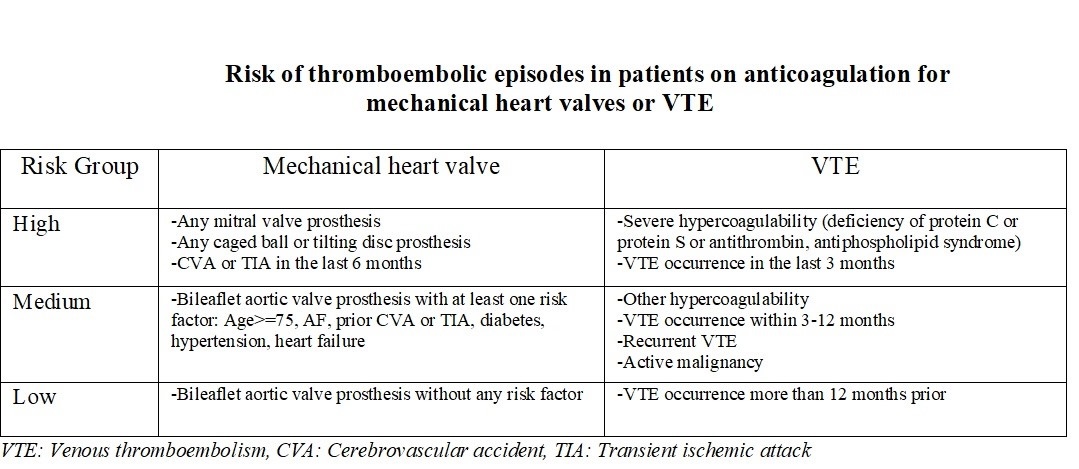
Thromboembolic Episode Risks. The table shows the risk of thromboembolism in patients on anticoagulation for mechanical heart valves or venous thromboembolism.
Adapted from Douketis JD, Spyropoulos AC, Spencer FA, et al. Perioperative management of antithrombotic therapy: Antithrombotic Therapy and Prevention of Thrombosis, 9th ed: American College of Chest Physicians Evidence-Based Clinical Practice Guidelines. 2012;141(2 suppl):e326S-e350S. doi: 10.1378/chest.11-2298.
References
Abraham NS, Barkun AN, Sauer BG, Douketis J, Laine L, Noseworthy PA, Telford JJ, Leontiadis GI. American College of Gastroenterology-Canadian Association of Gastroenterology Clinical Practice Guideline: Management of Anticoagulants and Antiplatelets During Acute Gastrointestinal Bleeding and the Periendoscopic Period. The American journal of gastroenterology. 2022 Apr 1:117(4):542-558. doi: 10.14309/ajg.0000000000001627. Epub [PubMed PMID: 35297395]
Level 1 (high-level) evidenceASGE Standards of Practice Committee, Acosta RD, Abraham NS, Chandrasekhara V, Chathadi KV, Early DS, Eloubeidi MA, Evans JA, Faulx AL, Fisher DA, Fonkalsrud L, Hwang JH, Khashab MA, Lightdale JR, Muthusamy VR, Pasha SF, Saltzman JR, Shaukat A, Shergill AK, Wang A, Cash BD, DeWitt JM. The management of antithrombotic agents for patients undergoing GI endoscopy. Gastrointestinal endoscopy. 2016 Jan:83(1):3-16. doi: 10.1016/j.gie.2015.09.035. Epub 2015 Nov 24 [PubMed PMID: 26621548]
Chan FKL, Goh KL, Reddy N, Fujimoto K, Ho KY, Hokimoto S, Jeong YH, Kitazono T, Lee HS, Mahachai V, Tsoi KKF, Wu MS, Yan BP, Sugano K. Management of patients on antithrombotic agents undergoing emergency and elective endoscopy: joint Asian Pacific Association of Gastroenterology (APAGE) and Asian Pacific Society for Digestive Endoscopy (APSDE) practice guidelines. Gut. 2018 Mar:67(3):405-417. doi: 10.1136/gutjnl-2017-315131. Epub 2018 Jan 13 [PubMed PMID: 29331946]
Level 1 (high-level) evidenceVeitch AM, Radaelli F, Alikhan R, Dumonceau JM, Eaton D, Jerrome J, Lester W, Nylander D, Thoufeeq M, Vanbiervliet G, Wilkinson JR, Van Hooft JE. Endoscopy in patients on antiplatelet or anticoagulant therapy: British Society of Gastroenterology (BSG) and European Society of Gastrointestinal Endoscopy (ESGE) guideline update. Gut. 2021 Sep:70(9):1611-1628. doi: 10.1136/gutjnl-2021-325184. Epub [PubMed PMID: 34362780]
Douketis JD, Spyropoulos AC, Murad MH, Arcelus JI, Dager WE, Dunn AS, Fargo RA, Levy JH, Samama CM, Shah SH, Sherwood MW, Tafur AJ, Tang LV, Moores LK. Perioperative Management of Antithrombotic Therapy: An American College of Chest Physicians Clinical Practice Guideline. Chest. 2022 Nov:162(5):e207-e243. doi: 10.1016/j.chest.2022.07.025. Epub 2022 Aug 11 [PubMed PMID: 35964704]
Level 1 (high-level) evidenceLip GY, Nieuwlaat R, Pisters R, Lane DA, Crijns HJ. Refining clinical risk stratification for predicting stroke and thromboembolism in atrial fibrillation using a novel risk factor-based approach: the euro heart survey on atrial fibrillation. Chest. 2010 Feb:137(2):263-72. doi: 10.1378/chest.09-1584. Epub 2009 Sep 17 [PubMed PMID: 19762550]
Level 2 (mid-level) evidenceLee CJ, Toft-Petersen AP, Ozenne B, Phelps M, Olesen JB, Ellinor PT, Gislason G, Lip GYH, Torp-Pedersen C, Gerds TA. Assessing absolute stroke risk in patients with atrial fibrillation using a risk factor-based approach. European heart journal. Cardiovascular pharmacotherapy. 2021 Apr 9:7(FI1):f3-f10. doi: 10.1093/ehjcvp/pvaa063. Epub [PubMed PMID: 32531029]
Douketis JD, Spyropoulos AC, Spencer FA, Mayr M, Jaffer AK, Eckman MH, Dunn AS, Kunz R. Perioperative management of antithrombotic therapy: Antithrombotic Therapy and Prevention of Thrombosis, 9th ed: American College of Chest Physicians Evidence-Based Clinical Practice Guidelines. Chest. 2012 Feb:141(2 Suppl):e326S-e350S. doi: 10.1378/chest.11-2298. Epub [PubMed PMID: 22315266]
Level 1 (high-level) evidenceVeitch AM, Vanbiervliet G, Gershlick AH, Boustiere C, Baglin TP, Smith LA, Radaelli F, Knight E, Gralnek IM, Hassan C, Dumonceau JM. Endoscopy in patients on antiplatelet or anticoagulant therapy, including direct oral anticoagulants: British Society of Gastroenterology (BSG) and European Society of Gastrointestinal Endoscopy (ESGE) guidelines. Endoscopy. 2016 Apr:48(4):c1. doi: 10.1055/s-0042-122686. Epub 2017 Jan 23 [PubMed PMID: 28114689]
Kwok A, Faigel DO. Management of anticoagulation before and after gastrointestinal endoscopy. The American journal of gastroenterology. 2009 Dec:104(12):3085-97; quiz 3098. doi: 10.1038/ajg.2009.469. Epub 2009 Aug 11 [PubMed PMID: 19672250]
Schulman S, Elbazi R, Zondag M, O'Donnell M. Clinical factors influencing normalization of prothrombin time after stopping warfarin: a retrospective cohort study. Thrombosis journal. 2008 Oct 16:6():15. doi: 10.1186/1477-9560-6-15. Epub 2008 Oct 16 [PubMed PMID: 18925967]
Level 2 (mid-level) evidenceGarcia DA, Regan S, Henault LE, Upadhyay A, Baker J, Othman M, Hylek EM. Risk of thromboembolism with short-term interruption of warfarin therapy. Archives of internal medicine. 2008 Jan 14:168(1):63-9. doi: 10.1001/archinternmed.2007.23. Epub [PubMed PMID: 18195197]
Level 2 (mid-level) evidenceDouketis JD, Spyropoulos AC, Kaatz S, Becker RC, Caprini JA, Dunn AS, Garcia DA, Jacobson A, Jaffer AK, Kong DF, Schulman S, Turpie AG, Hasselblad V, Ortel TL, BRIDGE Investigators. Perioperative Bridging Anticoagulation in Patients with Atrial Fibrillation. The New England journal of medicine. 2015 Aug 27:373(9):823-33. doi: 10.1056/NEJMoa1501035. Epub 2015 Jun 22 [PubMed PMID: 26095867]
Dubois V, Dincq AS, Douxfils J, Ickx B, Samama CM, Dogné JM, Gourdin M, Chatelain B, Mullier F, Lessire S. Perioperative management of patients on direct oral anticoagulants. Thrombosis journal. 2017:15():14. doi: 10.1186/s12959-017-0137-1. Epub 2017 May 15 [PubMed PMID: 28515674]
Weitz JI, Quinlan DJ, Eikelboom JW. Periprocedural management and approach to bleeding in patients taking dabigatran. Circulation. 2012 Nov 13:126(20):2428-32. doi: 10.1161/CIRCULATIONAHA.112.123224. Epub [PubMed PMID: 23147769]
Level 3 (low-level) evidencePatrono C, Ciabattoni G, Patrignani P, Pugliese F, Filabozzi P, Catella F, Davì G, Forni L. Clinical pharmacology of platelet cyclooxygenase inhibition. Circulation. 1985 Dec:72(6):1177-84 [PubMed PMID: 3933848]
Gurbel PA, Bliden KP, Butler K, Tantry US, Gesheff T, Wei C, Teng R, Antonino MJ, Patil SB, Karunakaran A, Kereiakes DJ, Parris C, Purdy D, Wilson V, Ledley GS, Storey RF. Randomized double-blind assessment of the ONSET and OFFSET of the antiplatelet effects of ticagrelor versus clopidogrel in patients with stable coronary artery disease: the ONSET/OFFSET study. Circulation. 2009 Dec 22:120(25):2577-85. doi: 10.1161/CIRCULATIONAHA.109.912550. Epub 2009 Nov 18 [PubMed PMID: 19923168]
Level 1 (high-level) evidenceEisenberg MJ, Richard PR, Libersan D, Filion KB. Safety of short-term discontinuation of antiplatelet therapy in patients with drug-eluting stents. Circulation. 2009 Mar 31:119(12):1634-42. doi: 10.1161/CIRCULATIONAHA.108.813667. Epub 2009 Mar 16 [PubMed PMID: 19289638]
Level 2 (mid-level) evidenceRubin TA, Murdoch M, Nelson DB. Acute GI bleeding in the setting of supratherapeutic international normalized ratio in patients taking warfarin: endoscopic diagnosis, clinical management, and outcomes. Gastrointestinal endoscopy. 2003 Sep:58(3):369-73 [PubMed PMID: 14528210]
Level 2 (mid-level) evidenceShingina A, Barkun AN, Razzaghi A, Martel M, Bardou M, Gralnek I, RUGBE Investigators. Systematic review: the presenting international normalised ratio (INR) as a predictor of outcome in patients with upper nonvariceal gastrointestinal bleeding. Alimentary pharmacology & therapeutics. 2011 May:33(9):1010-8. doi: 10.1111/j.1365-2036.2011.04618.x. Epub 2011 Mar 8 [PubMed PMID: 21385193]
Level 2 (mid-level) evidenceHolbrook A, Schulman S, Witt DM, Vandvik PO, Fish J, Kovacs MJ, Svensson PJ, Veenstra DL, Crowther M, Guyatt GH. Evidence-based management of anticoagulant therapy: Antithrombotic Therapy and Prevention of Thrombosis, 9th ed: American College of Chest Physicians Evidence-Based Clinical Practice Guidelines. Chest. 2012 Feb:141(2 Suppl):e152S-e184S. doi: 10.1378/chest.11-2295. Epub [PubMed PMID: 22315259]
Level 1 (high-level) evidenceNishimura RA, Otto CM, Bonow RO, Carabello BA, Erwin JP 3rd, Fleisher LA, Jneid H, Mack MJ, McLeod CJ, O'Gara PT, Rigolin VH, Sundt TM 3rd, Thompson A. 2017 AHA/ACC Focused Update of the 2014 AHA/ACC Guideline for the Management of Patients With Valvular Heart Disease: A Report of the American College of Cardiology/American Heart Association Task Force on Clinical Practice Guidelines. Journal of the American College of Cardiology. 2017 Jul 11:70(2):252-289. doi: 10.1016/j.jacc.2017.03.011. Epub 2017 Mar 15 [PubMed PMID: 28315732]
Level 1 (high-level) evidencePollack CV Jr, Reilly PA, Eikelboom J, Glund S, Verhamme P, Bernstein RA, Dubiel R, Huisman MV, Hylek EM, Kamphuisen PW, Kreuzer J, Levy JH, Sellke FW, Stangier J, Steiner T, Wang B, Kam CW, Weitz JI. Idarucizumab for Dabigatran Reversal. The New England journal of medicine. 2015 Aug 6:373(6):511-20. doi: 10.1056/NEJMoa1502000. Epub 2015 Jun 22 [PubMed PMID: 26095746]
Kato M, Uedo N, Hokimoto S, Ieko M, Higuchi K, Murakami K, Fujimoto K. Guidelines for Gastroenterological Endoscopy in Patients Undergoing Antithrombotic Treatment: 2017 Appendix on Anticoagulants Including Direct Oral Anticoagulants. Digestive endoscopy : official journal of the Japan Gastroenterological Endoscopy Society. 2018 Jul:30(4):433-440. doi: 10.1111/den.13184. Epub [PubMed PMID: 29733468]
Douketis JD, Spyropoulos AC, Duncan J, Carrier M, Le Gal G, Tafur AJ, Vanassche T, Verhamme P, Shivakumar S, Gross PL, Lee AYY, Yeo E, Solymoss S, Kassis J, Le Templier G, Kowalski S, Blostein M, Shah V, MacKay E, Wu C, Clark NP, Bates SM, Spencer FA, Arnaoutoglou E, Coppens M, Arnold DM, Caprini JA, Li N, Moffat KA, Syed S, Schulman S. Perioperative Management of Patients With Atrial Fibrillation Receiving a Direct Oral Anticoagulant. JAMA internal medicine. 2019 Nov 1:179(11):1469-1478. doi: 10.1001/jamainternmed.2019.2431. Epub [PubMed PMID: 31380891]