 Tools
Tools
 Forensic Gait Analysis
Introduction
Gait analysis refers to the systematic study of human movement during walking. In the forensic setting, gait analysis, or forensic gait comparison, involves assessing a suspect’s gait patterns and features and comparing them with gait evidence obtained from a crime scene for purposes of criminal or personal identification. In practice, this technique functions as a supportive contributor to the broader identification process rather than a standalone method, because the idea that an individual’s gait is uniquely identifiable has not yet been fully validated scientifically.[1] The forensic gait analysis's general source or evidence comprises the series of footprints found at the crime scene and the closed-circuit television camera (CCTV) footage. Footprints are evidence found at the crime scene. Footprints can be recovered in the form of bare prints, shoeprints, and a series of imprints. Footprints can be encountered in several types of cases and crime scenes, such as house break-ins and theft, robbery, sexual assaults, hit and run, shoplifting, homicides, and kidnapping. The science of footprints and gait analysis is a part of an emerging sub-discipline of forensic science known as forensic podiatry. Forensic podiatry is "the application of podiatric knowledge and experience in forensic investigations. It shows the association of an individual with a scene of a crime, or to answer any other legal question concerned with the foot or footwear that requires knowledge of the functioning foot."[2][3] The principles and knowledge of forensic podiatry help the investigating officers and crime scene investigators when they are involved with the foot, footwear, and/or gait-related evidence at the crime scene. This knowledge can further establish the suspect's physical or biological profile for individualization and identification.[2]
Meanwhile, an investigating officer is always on the lookout for evidence linking the suspect to the crime scene. In recent times, gait analysis has emerged as an important parameter for personal identification in forensic examinations. The advent of CCTV cameras and other surveillance technologies has generated interest in forensic gait analysis and its possible use in human individualization. In 1839, in London, gait analysis was introduced in court in the case of Thomas Jackson; a witness identified him due to his bowed left leg and limp.[4][5] However, for the very first time, the forensic gait analysis was used as a means of admissible evidence/scientific evidence in the Old Bailey Central Criminal Court, London, UK, in the case of R vs Saunders by the UK based forensic podiatrist, Dr. Haydn Kelly, although, the method of forensic gait analysis remains questionable as far as the reliability and accuracy are concerned.[1][4][6][4][7] The topic discusses forensic gait analysis methods, factors affecting human gait, its forensic applications, and its accuracy, reliability, and admissibility in court.
Function
Register For Free And Read The Full Article
 Search engine and full access to all medical articles
- 10 free questions in your specialty
- Free CME/CE Activities
- Free daily question in your email
- Save favorite articles to your dashboard
- Emails offering discounts
Learn more about a Subscription to StatPearls Point-of-Care
Function
Gait Analysis
Human walking occurs in a specific pattern, including various stages, which is referred to as a 'gait cycle.' It consists of 2 phases: the stance phase and the swing phase.[6] The stance Phase consists of 5 stages: "initial contact, loading response, mid-stance, terminal stance, pre-swing." The swing phase consists of 3 stages: "initial swing, mid-swing, and terminal swing."[8] See Image. Gait Cycle/Walk Cycle.
The dogma of forensic podiatry is to use proper, standardized methodology for the scientific examination of all evidence. The gait pattern examination includes ACE-VR, which stands for analysis, comparison, evaluation, verification, and report.[2] Every step needs to be considered. After a thorough analysis, the findings are presented in the report format. The forensic gait analysis would depend on the type of gait pattern. The gait pattern may be classified into the following 2 types:
- Gait analysis on the surface: The analysis of gait pattern on the surface (consisting of a minimum of 3 to 4 consecutive footprints/footwear prints) is performed by considering various parameters, including the dimensions, general shape of the prints, patterns in case if ridges are visible, margins of the prints, and toe marks. Measurements of step and stride length are considered, which may indicate the nature of an individual's gait pattern (e.g., normal gait, running), as well as any associated abnormalities. This analysis may also help approximate a suspect's stature, sex, age, and body weight. A profile of the contributor of the prints may be established. A comparison between the perpetrator and the suspect is made by systematically analyzing and scoring gait patterns.[9] Information on the relationships among step length, stride length, and footprint length and stature may be valuable for gait comparison and analysis. Some researchers have found a statistical correlation between a person's footstep length and stride length and their stature, accounting for various controlled conditions.[2][8][10][11]
- Gait analysis from CCTV footage/video recordings: The emergence of CCTV cameras and video-enabled devices (video cameras, mobile phones, dashboard cameras, surveillance cameras, and traffic cameras) has added a new dimension to gait analysis. Currently, video recordings and CCTV footage are used to analyze a person's gait.[5] Before the invention and use of CCTV, investigating agencies relied on eyewitnesses who might have 'seen' someone on the spot with a particular 'style of walking.' However, scientific evidence suggests that the discriminative strength of such statements cannot be relied upon as the sole evidence, although forensic gait analysis plays an important supportive role in the absence of other biometric identifiers in the video. CCTV footage from the scene of the offense, surveillance footage, traffic camera footage, dash-cam footage from dashboard-mounted cameras, and mobile phone recordings (by the victim, witness, or others) should be collected in accordance with the established process for collecting digital evidence. Usually, a copy of the recording is secured in a flash drive/hard disk of suitable capacity. The 'hash value' should be calculated and mentioned in the chain of custody form and the forwarding letter.
Forensic Gait Analysis Approaches
Forensic gait analysis may be human-based (observer-based) or computer-based. Both approaches are very briefly discussed below:
- Human-based: The human-based approach (also known as the observer-based approach) falls under 3 categories: photo-anthropometry, morphometric analysis, and superimposition. Photo-anthropometry involves measurements of predefined landmarks. Morphological measurements are taken from photographs in the morphometric analysis. Then, both the measurements are combined and superimposed to establish a match between suspect and standard photographs.[4] In the human-based approach, motion analysis is also performed by running videos in pause and reverse mode. This also helps identify the suspect through observation.[12][13] Nevertheless, this approach is often prone to errors and bias. The inter-observer and intra-observer variabilities are also beyond permissible limits most of the time. Additionally, various measurements are taken either directly on the footprints/gait pattern or with the help of photographs (with a scale of reference). Photogrammetry may also be used.
- Computer-based human-assisted: The computer-based analysis involves algorithms that can either be model-based or appearance-based. The model-based approach uses fixed landmarks to extract gait features. This is done by predefining the landmarks using a human model. Later, the appearance-based model functioned by extracting silhouette sequences of walking individuals. In this, a predefined human model is absent. In both cases, the match score is obtained between the questioned and suspected gait.[4][13]
Forensic Gait Analysis Features/Parameters
For traits or features to be useful for forensic purposes, they must follow certain principles, such as universality, permanence, and uniqueness. While some may be grouped under class characteristics, others under individual characteristics. Even if 1 or 2 features may not be proof enough for a conclusion, they yield a more reliable, scientifically sound result when combined. Although it is beyond the purview of this topic to detail the parameters/features used, as well as the factors affecting forensic gait analysis, a brief account is provided. Some of the features taken into consideration while performing forensic gait analysis (static as well as dynamic) that may contribute to the establishment of identity are as follows:
- Static measurements: These are the body's geometric measurements. For example, the whole leg length, the length of the knee, and the height of the foot.[8]
- Dynamic measurements: measurements related to gait. For example, the distance between both knees, the length of the stride, and the cadence.[8]
Another classification may include spatial, temporal, and angular displacement parameters.
- Spatial parameter (distance) - These parameters can be measured using the measurement of footprints by drawing a progression line, which is an imaginary line corresponding to the direction of walking. The parameters that may be included are step length, stride length, stride length/leg length ratio, stride or step width, longitudinal dimension, horizontal dimension, foot dimensions, foot line, direction line, foot angle, and gait line.
- Temporal parameter (time) - In the videos/footage, these parameters are measured using a stopwatch (manually) or with the help of automated/semi-automated software. It includes step time, stride time, stance duration, swing duration, swing/stance ratio, speed, and cadence.
- Angular displacement parameter (angle) - Various angles, like hip angle and knee angle, are also considered.
Issues of Concern
Factors Affecting Gait Pattern and Analysis
Gait is a biological characteristic of a person, and the gait pattern is simply the manner or style in which a person usually walks. It is highly influenced by many factors (internal as well as external). Walking is often not a conscious behavior and can be used for differentiation rather than identification. Some of the factors that tend to affect the gait and, hence, the forensic gait analysis are as follows:
- Footwear: It causes gait pattern variability. Some footwear can increase hip movement, resulting in a longer stride length, while others may reduce stride length.
- Fatigue: Fatigue depletes energy, affecting the gait cycle and influencing the gait pattern. Walking speed also decreases when a person is low on energy.
- Use of a knee brace: It also affects a person's gait.[14]
- Sex: Studies have revealed that the sex of a person can be assessed from the gait pattern, which supports that sex affects the gait pattern.[8]
- Speed: The gait pattern shows changes between the normal walking pattern and the person's running pattern.[8][14][15]
- Diseases/disorders/medical conditions: This is a common factor affecting a person's gait. A typical and time-specific gait pattern in the person suffering from such a condition is evident, e.g., Parkinsonian/Parkinson gait in Parkinson disease (see Video. Parkinson Gait).[9] Choreiform gait presents as the primary feature of Huntington disease (see Video. Choreiform Gait). Other conditions may include chronic rheumatoid disease, Sydenham chorea, involuntary movement, festinant gait, shuffling gait, and scissor gait. See Image. Scissors Gait.
- Directed gait: Directional gait is walking under the instruction. For example, in marching, everyone shows a similar gait.
- Age: Age is a factor that influences gait patterns. Walking depends on muscle strength, which gradually changes as a person grows. The variations in muscle strength affect gait.
- First trimester of pregnancy: It is believed that the gait pattern changes during this period. A study has shown that foot angle exhibits changes during the first trimester of pregnancy.[16]
- Location: The surface a person walks on also affects gait, as walking on a surface different from usual requires greater focus, making him or her more conscious and altering the walking pattern.[15]
- Camera: The type of camera used also affects gait analysis. The angle and positioning of the camera are also found to be crucial. The quality of the recording received for comparison, if unclear, may result in misinterpretation or inconclusive results.
- Lighting conditions: The angle and direction of light, as well as the direction of the person's movement, also affect gait pattern analysis.
In addition to the factors mentioned above, several others can affect an individual's walking pattern, including emotional state, music, talking, load carriage, and attire.[8][17] The person may try to introduce some gait changes intentionally to avoid being recognized in the footage or to avoid suspicion. This artificial 'gait,' ie, deliberate change in the gait, also needs to be considered by the forensic analyst/examiner.
Clinical Significance
Forensic Significance
According to Birch et al, forensic gait analysis is "the identification of a person or persons by their gait or features of their gait, usually from closed-circuit television (CCTV) footage and comparison to footage of a known individual."[6] It means the main source of comparison is CCTV footage and other videos that can be used in the analysis. In other words, it is the visual comparison of videos to identify individuals based on gait patterns. This knowledge has been used in crime scene investigations, particularly to identify the criminal or perpetrator based on gait characteristics. Many forensic cases have been solved, and criminals have been convicted worldwide through forensic gait analysis.[2][18] Presently, Drs. Michael Nirenberg and Christine Miller in the USA, Dr. Nicholas Harris in Canada, and Professor Ivan Birch, Dr. Jai Saxelby, and Dr. Jeremy Walker in the UK regularly practice forensic gait analysis.
Indirect Forensic Significance
The forensic gait analysis may additionally help in the estimation of stature and sex of the person,[2][19] estimation of body weight,[19] estimation of the number of people involved by measuring and evaluating step length/stride length if a series of footprints or gait patterns are available for analysis. The gait analysis may also help comment on the type of footwear used, the use of any walking aid or support (such as a walking stick), and any underlying disease/disorder/medical condition affecting the gait.
Clinical Significance
Clinical gait analysis helps assess and treat individuals with neurological conditions that may affect their ability to walk. With the help of gait analysis, podiatrists, neurologists, and orthopedic surgeons usually diagnose the causes of pain, such as muscles, nerves, and skeletal problems, and consequently initiate treatment to correct gait-related abnormalities and develop rehabilitation protocols.[20][21] Gait analysis is being used in several fields, including sports science, rehabilitation and recovery medicine, kinesiology, and orthopedics.
Other Issues
Limitations of Forensic Gait Analysis and Criticism About Its Admissibility in the Court of Law
In the present era, due to a paradigm shift in forensic science, there is an increased focus on the reliability, accuracy, quality of evidence, and its admissibility in court. Forensic gait analysis has also been criticized for its reproducibility, reliability, and lack of proper standards and rules of forensic practice.[7]
Gait pattern, or walking pattern, is highly affected by the various parameters mentioned above, which puts the investigating officer in a situation that requires consideration of several factors, making it practically impossible to identify a single suspect. Another limitation of gait pattern analysis is that we lack databases for gait comparison. Gait pattern shows high intra-individual variability. It means a person's gait is highly variable across different occasions and scenarios, making it challenging to identify them.[22] Moreover, the experts are not following any prescribed protocol for gait analysis; consequently, there are variations in the methodologies used, which create confusion among the judges and jury when deciding cases based on this parameter of identification.[4]
Presently, the research is being carried out in the area of automated gait recognition, using larger & variable datasets, tested variables, and enhanced statistical evaluation of results. Despite these improvements, any forensic evidence lacking fully recommended codes of practice and standardized procedures, and with error rates in reproducibility and repeatability, should be treated with caution in forensic scenarios.[7] Forensic gait analysis remained a weak method of identification, as the experts' observation of gait features varies across situations. A study conducted by forensic gait analysts shows that there is a significant difference in the observation of gait features between experienced experts, who made precise decisions in 71% of the cases.[23] Studies also indicate differences in capability and confidence between qualified (competent/skilled/experienced/knowledgeable) and inexperienced gait analysts, and caution about the evidence submitted by inexperienced gait analysts.[1]
Enhancing Healthcare Team Outcomes
Irrespective of the limitations and criticisms regarding individuality and uniqueness, and their admissibility in court, forensic gait analysis may be considered supporting/corroborative evidence for identifying criminals and perpetrators. Many forensic cases have been solved, and criminals have been convicted worldwide through forensic gait analysis.
Media
(Click Video to Play)
Parkinson Gait, Involuntary Movement, Festinant Gait, Video. This video describes different gaits and involuntary movements.
Contributed by RS Kumar, MD
(Click Video to Play)
Choreiform Gait. Choreiform gait, involuntary movement, is the primary feature of Huntington disease, chronic rheumatoid disease, and Sydenham chorea.
Contributed by RS. Menon, MD
(Click Image to Enlarge)
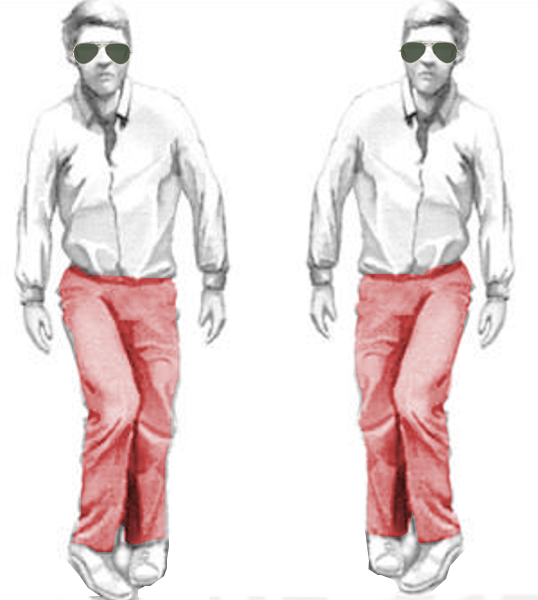
Scissor Gait. This image shows a man with a scissor gait.
Contributed by S Bhimji, MD
(Click Image to Enlarge)
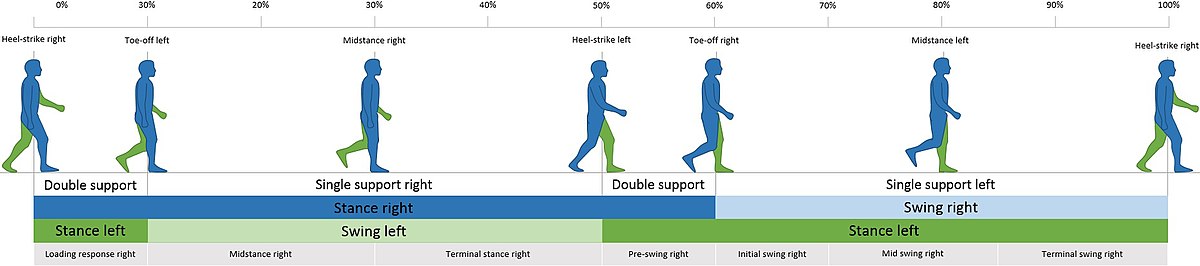
The Gait Cycle/Walk Cycle. This image illustrates the walk cycle, from the double support to the final heel-strike right.
BoH, Public Domain, via Wikimedia Commons
References
Birch I, Birch M, Asgeirsdottir N. The identification of individuals by observational gait analysis using closed circuit television footage: Comparing the ability and confidence of experienced and non-experienced analysts. Science & justice : journal of the Forensic Science Society. 2020 Jan:60(1):79-85. doi: 10.1016/j.scijus.2019.10.002. Epub 2019 Oct 22 [PubMed PMID: 31924292]
Krishan K, Kanchan T, DiMaggio JA. Emergence of forensic podiatry--A novel sub-discipline of forensic sciences. Forensic science international. 2015 Oct:255():16-27. doi: 10.1016/j.forsciint.2015.06.012. Epub 2015 Jun 23 [PubMed PMID: 26163192]
Kanchan T, Krishan K, ShyamSundar S, Aparna KR, Jaiswal S. Analysis of footprint and its parts for stature estimation in Indian population. Foot (Edinburgh, Scotland). 2012 Sep:22(3):175-80. doi: 10.1016/j.foot.2012.02.010. Epub 2012 Mar 26 [PubMed PMID: 22456109]
Nirenberg M, Vernon W, Birch I. A review of the historical use and criticisms of gait analysis evidence. Science & justice : journal of the Forensic Science Society. 2018 Jul:58(4):292-298. doi: 10.1016/j.scijus.2018.03.002. Epub 2018 Mar 7 [PubMed PMID: 29895463]
Mukhra R, Krishan K, Kanchan T. Bare footprint metric analysis methods for comparison and identification in forensic examinations: A review of literature. Journal of forensic and legal medicine. 2018 Aug:58():101-112. doi: 10.1016/j.jflm.2018.05.006. Epub 2018 May 9 [PubMed PMID: 29777981]
Birch I, Vernon W, Walker J, Young M. Terminology and forensic gait analysis. Science & justice : journal of the Forensic Science Society. 2015 Jul:55(4):279-84. doi: 10.1016/j.scijus.2015.03.002. Epub 2015 Mar 28 [PubMed PMID: 26087876]
Macoveciuc I, Rando CJ, Borrion H. Forensic Gait Analysis and Recognition: Standards of Evidence Admissibility. Journal of forensic sciences. 2019 Sep:64(5):1294-1303. doi: 10.1111/1556-4029.14036. Epub 2019 Feb 21 [PubMed PMID: 30791120]
Seckiner D, Mallett X, Maynard P, Meuwly D, Roux C. Forensic gait analysis - Morphometric assessment from surveillance footage. Forensic science international. 2019 Mar:296():57-66. doi: 10.1016/j.forsciint.2019.01.007. Epub 2019 Jan 19 [PubMed PMID: 30690252]
van Mastrigt NM, Celie K, Mieremet AL, Ruifrok ACC, Geradts Z. Critical review of the use and scientific basis of forensic gait analysis. Forensic sciences research. 2018:3(3):183-193. doi: 10.1080/20961790.2018.1503579. Epub 2018 Oct 9 [PubMed PMID: 30483668]
Jasuja OP, Manjula. Estimation of stature from footstep length. Forensic science international. 1993 Sep:61(1):1-5 [PubMed PMID: 8225138]
Kanchan T, Sinha S, Krishan K. Is There a Correlation Between Footstep Length, Lower Extremities, and Stature? Journal of forensic sciences. 2015 Sep:60(5):1337-40. doi: 10.1111/1556-4029.12798. Epub 2015 Jul 28 [PubMed PMID: 26218919]
Birch I, Gwinnett C, Walker J. Aiding the interpretation of forensic gait analysis: Development of a features of gait database. Science & justice : journal of the Forensic Science Society. 2018 Jan:58(1):78-82. doi: 10.1016/j.scijus.2017.08.006. Epub 2017 Aug 25 [PubMed PMID: 29332699]
Sandau M, Heimbürger RV, Jensen KE, Moeslund TB, Aanaes H, Alkjaer T, Simonsen EB. Reliable Gait Recognition Using 3D Reconstructions and Random Forests - An Anthropometric Approach. Journal of forensic sciences. 2016 May:61(3):637-48. doi: 10.1111/1556-4029.13015. Epub 2016 Jan 6 [PubMed PMID: 27122399]
Inai T, Takabayashi T, Edama M, Kubo M. Evaluation of factors that affect hip moment impulse during gait: A systematic review. Gait & posture. 2018 Mar:61():488-492. doi: 10.1016/j.gaitpost.2018.02.017. Epub 2018 Feb 19 [PubMed PMID: 29494823]
Level 1 (high-level) evidenceNguyen DP, Phan CB, Koo S. Predicting body movements for person identification under different walking conditions. Forensic science international. 2018 Sep:290():303-309. doi: 10.1016/j.forsciint.2018.07.022. Epub 2018 Aug 2 [PubMed PMID: 30103180]
Forczek W, Masłoń A, Frączek B, Curyło M, Salamaga M, Suder A. Does the first trimester of pregnancy induce alterations in the walking pattern? PloS one. 2019:14(1):e0209766. doi: 10.1371/journal.pone.0209766. Epub 2019 Jan 16 [PubMed PMID: 30650108]
Licence S, Smith R, McGuigan MP, Earnest CP. Gait Pattern Alterations during Walking, Texting and Walking and Texting during Cognitively Distractive Tasks while Negotiating Common Pedestrian Obstacles. PloS one. 2015:10(7):e0133281. doi: 10.1371/journal.pone.0133281. Epub 2015 Jul 29 [PubMed PMID: 26222430]
Lynnerup N, Vedel J. Person identification by gait analysis and photogrammetry. Journal of forensic sciences. 2005 Jan:50(1):112-8 [PubMed PMID: 15831004]
Level 3 (low-level) evidenceBaryah N, Krishan K, Kanchan T. The development and status of forensic anthropology in India: A review of the literature and future directions. Medicine, science, and the law. 2019 Jan:59(1):61-69. doi: 10.1177/0025802418824834. Epub 2019 Jan 19 [PubMed PMID: 30661453]
Level 3 (low-level) evidenceKuo AD, Donelan JM. Dynamic principles of gait and their clinical implications. Physical therapy. 2010 Feb:90(2):157-74. doi: 10.2522/ptj.20090125. Epub 2009 Dec 18 [PubMed PMID: 20023002]
Braga Rodrigues T, Ó Catháin C, O'Connor NE, Murray N. A Quality of Experience assessment of haptic and augmented reality feedback modalities in a gait analysis system. PloS one. 2020:15(3):e0230570. doi: 10.1371/journal.pone.0230570. Epub 2020 Mar 23 [PubMed PMID: 32203533]
Level 2 (mid-level) evidenceGibelli D, Obertová Z, Ritz-Timme S, Gabriel P, Arent T, Ratnayake M, De Angelis D, Cattaneo C. The identification of living persons on images: A literature review. Legal medicine (Tokyo, Japan). 2016 Mar:19():52-60. doi: 10.1016/j.legalmed.2016.02.001. Epub 2016 Feb 1 [PubMed PMID: 26980255]
Birch I, Raymond L, Christou A, Fernando MA, Harrison N, Paul F. The identification of individuals by observational gait analysis using closed circuit television footage. Science & justice : journal of the Forensic Science Society. 2013 Sep:53(3):339-42. doi: 10.1016/j.scijus.2013.04.005. Epub 2013 May 17 [PubMed PMID: 23937944]