 Tools
Tools
 Biochemistry, HLA Antigens
Introduction
Human leukocyte antigens (HLA) are genes in the major histocompatibility complex (MHC) that encode proteins that help differentiate self from non-self. They play a significant role in disease and immune defense. They are beneficial to the immune system but can also have detrimental effects. Some of the immune system effects include interactions with complement, cytotoxic effects of T cells, and cellular and humoral immunity. Additionally, they play a role in autoimmunity and remain targets of researchers for their further effects and interactions.[1]
Fundamentals
Register For Free And Read The Full Article
 Search engine and full access to all medical articles
- 10 free questions in your specialty
- Free CME/CE Activities
- Free daily question in your email
- Save favorite articles to your dashboard
- Emails offering discounts
Learn more about a Subscription to StatPearls Point-of-Care
Fundamentals
Human leukocyte antigens are of 3 main types. Class I HLA antigens include HLA-A, B, and C molecules; class II, which includes the HLA-DR, -DQ, and -DP loci, is expressed on antigen-presenting cells; and class III contains genes for proteins with immune function.[1]
Issues of Concern
HLA antigen sensitization can become a problem for patients undergoing procedures such as stem cell transplants. HLA antigens have a significant role in transplant-mediated rejection, which falls under the following 2 categories:
T-cell-mediated Rejection
In T-cell-mediated rejection, the T-cell becomes activated through interaction between the T-cell receptor and the HLA-peptide complex from the donor.
Antibody-mediated Rejection
In antibody-mediated rejection, T helper cells are co-stimulated, and a concurrent inflammatory response leads to recognition of foreign HLA molecules. Given the possibility of these 2 types of rejection, laboratories measure HLA antibodies in circulation to assess the risk of rejection.[1] HLA types were also associated with an increased risk of specific diseases. For example, early-onset myasthenia gravis is associated with HLA-B8 as the sole genetic factor leading to disease onset.[2] Although of unknown etiology, multiple sclerosis has been shown to have a high rate of correlation with the HLA-DR2 antigen.[3] Additionally, rheumatoid arthritis has been shown to precipitate complex biological interactions in the body. Some of these interactions include HLA-DR4, a glycopeptide from type II collagen, and a T-cell receptor, all of which have been shown to correlate with the development of rheumatoid arthritis.[4]
Cellular Level
HLA class I molecules are present on all nucleated cell surfaces and present intracellular peptides to cytotoxic T cells in the immune system.[4] HLA plays a role in cellular immunity, particularly noted in transplant reactions. Particular antibodies, such as anti-HLA-B and anti-HLA-DQ, can bind complement.[5]
Molecular Level
HLA antigens can vary, and researchers have investigated their presence and function to determine their role in disease diagnosis and treatment. HLA polymorphisms can vary with the epidemiological composition of a particular population, so this is an important area of research to further explore as technology advances. Studies can be conducted on specific human demographics to learn more about the prevalence of particular diseases that have a predilection for certain groups. For example, in 2018, a trial was conducted in Thailand to evaluate the efficacy of a Dengue vaccine. The HLA antigens were mapped across the population, and researchers identified 201 distinct HLA antigens using next-generation sequencing techniques. Through this investigation, researchers identified HLA alleles with higher frequencies in the population and could incorporate that information to begin applying it to disease associations.[6]
Function
HLA antigens, particularly the A, B, and C loci, are highly variable, especially in the extracellular domains, as evidenced by the over 300 class I alleles that researchers have identified.[5] The parts of the HLA antigens that are the most variable reside near the peptide-binding groove. Variability alters interactions with T-cell receptors and peptide-binding specificity, thereby changing the function of HLA antigens and potentially affecting the immune response and disease resistance.[4] In addition to their variability and function as peptide receptors, they act at different sites with beta-2-microglobulin, an alpha-beta T-cell receptor, and inhibitory molecules.[7] The various alleles within each HLA antigen class enable these additional functions.
Testing
Types of tests include cellular assays, immunologic, and molecular tests. Conventionally, HLA class alleles are detected by polymerase chain reaction (PCR). PCR uses variable exon sequences that encode the first amino acid of the HLA domains. From there, the HLA sequences from the database are used in hybridization with the amplified PCR products.[8] There have also been recent developments in lower-cost assays for detecting specific HLA antigens, such as high-resolution melting assays.[9]
The standard technique for identifying HLA class I and class II antigens has been the complement-mediated microlymphocytotoxicity technique. In this technique, HLA sera are obtained from alloimmunized women, and the corresponding specificities are determined by matching against a panel of known HLA types.[8] Testing for HLA antigens is often done using bead-based multiplex immunoassay technology. In this test, HLA protein beads coat the surface of microspheres. A fluorescence quantification system measures the level of HLA antibody binding on each bead.
Testing in patients with HLA antibodies in their circulation requires a cross-match before transplantation. This traditional cross-match entails mixing patient serum with donor-derived lymphocytes. "Virtual" cross-matches may also be performed to estimate transplant risk by measuring circulating HLA antibody levels using single-antigen beads and bead-based multiplex immunoassay systems.[3] Solid-phase assay (SPA) is a technique used in histocompatibility testing to identify alloantibodies. In solid-phase assays (SPAs), purified molecules, usually HLA proteins, coat a solid-phase medium. When incubated with patient sera, the solid phase medium adsorbs any antibodies specific to the antigens, which are subsequently identified with secondary fluorochrome-labeled reagents. SPA methods are extremely sensitive, detecting much smaller antibody titers than previously possible by cytotoxicity methods.[10]
Pathophysiology
Often, the specific pathophysiology of HLA antigen-disease associations is not well understood. However, HLA antigens play a role in autoimmunity. For example, in type I diabetes mellitus, the DR3-DQ2 haplotype is seen at an increased percent compared to the general population. The same haplotype is also associated with juvenile autoimmune thyroiditis. Other haplotypes can confer protection against diseases, such as DRB1*14:01, which protects against type I diabetes.[11]
Clinical Significance
Graft-versus-host Disease
A major clinical significance of HLA antigens is their role in transplant rejection. The opposite can occur when immune cells are transplanted with the graft into the recipient. Hematopoietic progenitor cell transplantation (eg, bone marrow transplantation, stem cell transplantation) must primarily address this phenomenon. Graft-versus-host disease (GVHD) is caused by donor antibodies against HLA class II antigens. A study at Henri-Mondor University Hospital in France demonstrated that donor antibodies against specific recipient HLA antigens correlate with the incidence of GVHD.[3] A study in the UK of stem cell transplants between 1996 and 2003 showed that patients with a class I HLA mismatch were more likely to develop chronic GVHD. Additionally, pairs with mismatches had a higher mortality rate after 1 year. Multiple HLA mismatches are associated with higher rates of GVHD.[12]
HLA antigens can be matched when administering blood products. Research has demonstrated that blood banks that use blood donors' HLA genotypes achieve better transfusion outcomes. There has been discussion of creating a database of genotyped donors to make it slightly easier to find blood for patients with rare HLA antibodies, so their transfusions carry a lower risk of adverse outcomes by using matched donors.[13] As discussed above, studies have identified particular HLA antigens that correlate with disease processes. These allow for the development of specific treatments for diseases.
Multiple Sclerosis
HLA-DR2 is associated with multiple sclerosis. Given the strong association between the disease and the DR2 antigen, studies have examined immunotherapy targeting the DR2 antigen for its treatment. In a particular study, the molecule PV-267 was examined for its promise as a therapy. PV-267 functions as a cytokine inhibitor and inhibits the proliferation of myelin-specific DR2 antigens. Using PV-267 derived from multiple sclerosis patients, researchers identified potential for further therapeutic options.[14]
Rheumatoid Arthritis
Rheumatoid arthritis shows a strong association with HLA-DR4. These have been thought to indicate susceptibility to disease. When DR4 binds with a class II-associated peptide, it may indicate an increased risk for rheumatoid arthritis. The DR4 binding alters the presentation of citrullinated peptides, contributing to disease development.[15]
Graves Disease
Graves' disease is associated with HLA-DR3. In addition to environmental factors, the HLA haplotype plays a significant role in disease development. Clinically, HLA typing may help to predict the outcome of Graves' disease before and after antithyroid medical therapy.[16] The typing can be used to associate increased and decreased allele values during therapy.[17]
Behçet Disease
Behçet disease is associated with HLA-B51, which influences its clinical features. Patients with the HLA-B51 haplotype have been shown to develop symptoms of the disease earlier in life (before age 40). Additionally, neurological and gastrointestinal symptoms of the disease were more prevalent in patients without the HLA-B51 haplotype than in those who had it.[18]
Media
(Click Image to Enlarge)
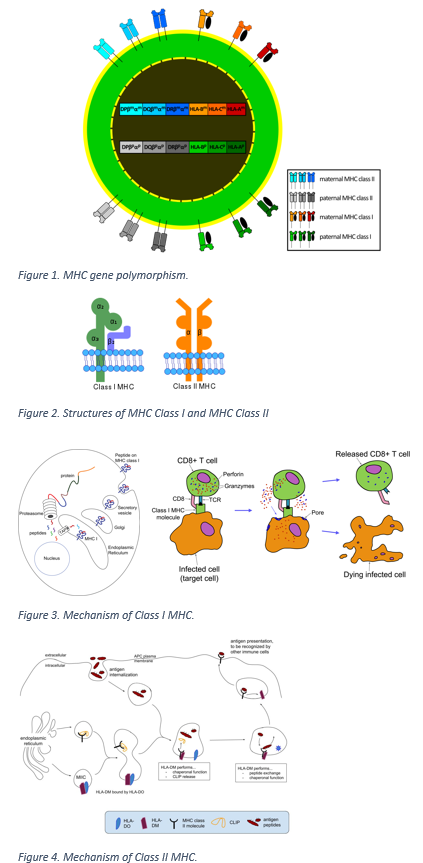
HLA/MHC gene polymorphism, structure, and mechanism Contributed from the Wikimedia Gallery (CC BY-2.5 https://creativecommons.org/licenses/by/2.5/)
References
Carey BS, Poulton KV, Poles A. Factors affecting HLA expression: A review. International journal of immunogenetics. 2019 Oct:46(5):307-320. doi: 10.1111/iji.12443. Epub 2019 Jun 10 [PubMed PMID: 31183978]
Gotfredsen A, Pødenphant J, Nørgaard H, Nilas L, Nielsen VA, Christiansen C. Accuracy of lumbar spine bone mineral content by dual photon absorptiometry. Journal of nuclear medicine : official publication, Society of Nuclear Medicine. 1988 Feb:29(2):248-54 [PubMed PMID: 3346735]
Delbos F, Barhoumi W, Cabanne L, Beckerich F, Robin C, Redjoul R, Astati S, Toma A, Pautas C, Ansart-Pirenne H, Cordonnier C, Bierling P, Maury S. Donor Immunization Against Human Leukocyte Class II Antigens is a Risk Factor for Graft-versus-Host Disease. Biology of blood and marrow transplantation : journal of the American Society for Blood and Marrow Transplantation. 2016 Feb:22(2):292-299. doi: 10.1016/j.bbmt.2015.09.027. Epub 2015 Nov 11 [PubMed PMID: 26453972]
Parham P. Function and polymorphism of human leukocyte antigen-A,B,C molecules. The American journal of medicine. 1988 Dec 23:85(6A):2-5 [PubMed PMID: 2462346]
Ayna TK, Koçyİğİt AÖ, Soypaçaci Z, Tuğmen C, Pirim I. Investigation of Anti-HLA Antibodies of Highly Sensitized Patients by Single Antigen Bead and C1q Tests. Transplantation proceedings. 2019 May:51(4):1024-1026. doi: 10.1016/j.transproceed.2019.01.086. Epub 2019 Feb 8 [PubMed PMID: 31101164]
Geretz A, Ehrenberg PK, Bouckenooghe A, Fernández Viña MA, Michael NL, Chansinghakule D, Limkittikul K, Thomas R. Full-length next-generation sequencing of HLA class I and II genes in a cohort from Thailand. Human immunology. 2018 Nov:79(11):773-780. doi: 10.1016/j.humimm.2018.09.005. Epub 2018 Sep 19 [PubMed PMID: 30243890]
Kostyu DD, Hannick LI, Traweek JL, Ghanayem M, Heilpern D, Dawson DV. HLA class I polymorphism: structure and function and still questions. Human immunology. 1997 Sep 15:57(1):1-18 [PubMed PMID: 9438190]
Smirnova LI. [Climacteric cardioneurosis]. Fel'dsher i akusherka. 1989 Dec:54(12):54-7 [PubMed PMID: 2628004]
Level 3 (low-level) evidenceImperiali C, Alía-Ramos P, Padró-Miquel A. Rapid detection of HLA-B*51 by real-time polymerase chain reaction and high-resolution melting analysis. Tissue antigens. 2015 Aug:86(2):139-42. doi: 10.1111/tan.12603. Epub 2015 Jul 14 [PubMed PMID: 26176813]
Gebel HM, Bray RA. HLA antibody detection with solid phase assays: great expectations or expectations too great? American journal of transplantation : official journal of the American Society of Transplantation and the American Society of Transplant Surgeons. 2014 Sep:14(9):1964-75. doi: 10.1111/ajt.12807. Epub 2014 Aug 1 [PubMed PMID: 25088978]
Fawwad A, Govender D, Ahmedani MY, Basit A, Lane JA, Mack SJ, Atkinson MA, Henry Wasserfall C, Ogle GD, Noble JA. Clinical features, biochemistry and HLA-DRB1 status in youth-onset type 1 diabetes in Pakistan. Diabetes research and clinical practice. 2019 Mar:149():9-17. doi: 10.1016/j.diabres.2019.01.023. Epub 2019 Jan 30 [PubMed PMID: 30710658]
Shaw BE. The clinical implications of HLA mismatches in unrelated donor haematopoietic cell transplantation. International journal of immunogenetics. 2008 Aug:35(4-5):367-74. doi: 10.1111/j.1744-313X.2008.00793.x. Epub [PubMed PMID: 18976440]
Dutra VF, Bub CB, Costa TH, Santos LD, Bastos EP, Aravechia MG, Kutner JM. Allele and haplotype frequencies of human platelet and leukocyte antigens in platelet donors. Einstein (Sao Paulo, Brazil). 2019 Feb 7:17(1):eAO4477. doi: 10.31744/einstein_journal/2019AO4477. Epub 2019 Feb 7 [PubMed PMID: 30758400]
Andrews LP, Clark RK, Damjanov I. Mixed glycosidase pretreatment reduces nonspecific binding of antibodies to frozen tissue sections. The journal of histochemistry and cytochemistry : official journal of the Histochemistry Society. 1985 Jul:33(7):695-8 [PubMed PMID: 3891844]
Level 3 (low-level) evidenceMiyadera H, Tokunaga K. Associations of human leukocyte antigens with autoimmune diseases: challenges in identifying the mechanism. Journal of human genetics. 2015 Nov:60(11):697-702. doi: 10.1038/jhg.2015.100. Epub 2015 Aug 20 [PubMed PMID: 26290149]
Matsuo T, Ushiroda Y. IDENTICAL TWIN SISTERS WITH CLOSE ONSET OF GRAVES' DISEASE AND WITH MULTIPLE HLA SUSCEPTIBILITY ALLELES FOR GRAVES' DISEASE. Acta endocrinologica (Bucharest, Romania : 2005). 2016 Jan-Mar:12(1):91-95. doi: 10.4183/aeb.2016.91. Epub [PubMed PMID: 31258808]
Vita R, Lapa D, Trimarchi F, Vita G, Fallahi P, Antonelli A, Benvenga S. Certain HLA alleles are associated with stress-triggered Graves' disease and influence its course. Endocrine. 2017 Jan:55(1):93-100. doi: 10.1007/s12020-016-0909-6. Epub 2016 Mar 7 [PubMed PMID: 26951052]
Ryu HJ, Seo MR, Choi HJ, Baek HJ. Clinical phenotypes of Korean patients with Behcet disease according to gender, age at onset, and HLA-B51. The Korean journal of internal medicine. 2018 Sep:33(5):1025-1031. doi: 10.3904/kjim.2016.202. Epub 2017 Jan 12 [PubMed PMID: 28073242]