 Tools
Tools
 Cordotomy
Introduction
Cordotomy is the name of a surgical procedure aimed at destroying the pain-conducting tracts of the spinal cord. First performed in 1912 by neurosurgeons William Spiller and Edward Martin, cordotomy effectively reduced pain and temperature sensation in patients with painful conditions. It was originally widely used for chronic pain, but now it has been adapted for use in patients with cancer only. The open procedure is rarely performed due to the high risk and complication rates observed previously.
The open method was further adapted into a percutaneous cervical cordotomy in 1963 (see Image. Percutaneous Cordotomy). In the 1990s, with improvements in pain management, the cordotomy again fell out of favor. However, it is still a palliative option for therapy-resistant pain. Given the population that receives this procedure, there is severely limited availability of studies testing its long-term effects. There is a case study of a patient with seminoma who underwent a right-sided percutaneous cervical cordotomy and chemotherapy. Five years later, the physicians found that the patient had continued sensory impairment with minimal effects on motor and autonomic function.[1]
Anatomy and Physiology
Register For Free And Read The Full Article
 Search engine and full access to all medical articles
- 10 free questions in your specialty
- Free CME/CE Activities
- Free daily question in your email
- Save favorite articles to your dashboard
- Emails offering discounts
Learn more about a Subscription to StatPearls Point-of-Care
Anatomy and Physiology
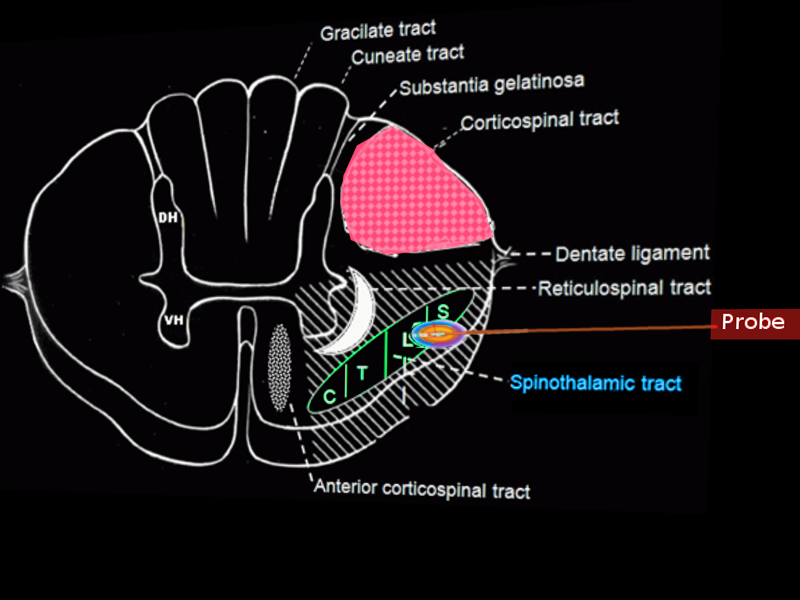
Today, with the percutaneous cervical cordotomy, the nociceptive pathways in the lateral spinothalamic tract (in the anterolateral column) are destroyed in the cervical spinal cord at the level of C1-C2.[2]
Indications
The original approach focused on pain relief for patients with unilateral malignancies, lower extremity pathologies, failed back syndrome, chronic nociceptive painful conditions, and cancer patients. On the other hand, bilateral cordotomies for visceral or bilateral pain are also an option. In the more recent percutaneous approach, the destruction of the lateral spinothalamic tract at the level of C1-C2 results in a contralateral disruption of painful sensations beyond C4. Today, this latter approach is most commonly used in patients with limited life expectancy and suffering from opioid-resistant cancer pain. Irrespective of the procedure or technique, a uniform indication for this intervention is having severe intractable pain that has not responded to conventional therapies. Cancer-related pain is an indication but not a requirement, as it can be done in populations suffering from other irreversible painful conditions. The severity of pain is essential when assessing appropriate indications. The patient's pain must have advanced to level 3 of the World Health Organization (WHO) pain ladder before considering this invasive procedure.
The cordotomy has been documented as particularly impactful for pain secondary to mesothelioma, Pancoast syndrome, and lung cancer.[3]
Contraindications
Percutaneous cordotomy is contraindicated in patients with a coagulation disorder, severely reduced ventilator function, or if a patient is unable to cooperate.[4] Several alternative procedures were developed in the 20th century. The commissural myelotomy was developed for bilateral pain arising from pelvic or abdominal neoplastic disease. Likewise, the punctate or limited midline myelotomy also aimed at pelvic and abdominal visceral pain. Therefore, if patients have pain localized solely to these regions, cordotomy can be avoided and newer procedures adopted. With the introduction of intrathecal pumps and spinal cord stimulators, it is prudent to steer many patients away from cordotomies.[5]
Technique or Treatment
Most cordotomies utilize the percutaneous approach at the level of C1-C2. The surgeon often uses fluoroscopic or computed tomography guidance. Patients are usually awake for the procedure, which is performed under local anesthesia. A laminectomy is required to execute an open cordotomy. It entails a longer recovery and a higher risk of side effects. However, when percutaneous cordotomy is unfeasible, especially in children, the open procedure is preferred.[6]
Complications
Only a few experience serious post-procedure side effects.[7] They include dysesthesia, urinary retention, ataxia, paresis, sympathetic dysfunction (hypotension, Horner syndrome, and bladder dysfunction), sexual sensitivity impaired or lost sexual sensitivity, and a form of sleep apnea (acquired central hypoventilation syndrome). The bulk of these complications result from the accidental division of the unintended reticulospinal tracts. Another serious complication is spontaneous new pain. New pain may be old (previously extant) pain that was previously unrecognized and now unmasked by removing prior distractions. Likewise, the new pain can be viewed as an unpreventable complication from the interruption of nociceptive pathways.
Overall, the risk of severe complications with unilateral cordotomy is low. Procedure-related mortality is reported in the range of 1%-6%, which is mainly due to respiratory dysfunction.[8] With more accurate ablation techniques, respiratory dysfunction is rare.[9]
Clinical Significance
Percutaneous cervical cordotomy is recommended for patients with a life expectancy of fewer than 6 months who also meet the pain severity indications. It is a palliative procedure. Successful, immediate pain relief results in approximately three-quarters of patients. However, the rate of pain relief declines to less than 50% after 2 years. As noted earlier, new pain syndromes can also arise, and patients must be aware of and willing to accept that risk. As measures of efficacy, clinical significance, and side effects, a study reported diminished touch perception on the left side of the body, consistent with an anterior spinothalamic tract lesion. The nearby anterior spinocerebellar tract, reticulospinal tract, and corticospinal tract were presumed to be spared, as the patient exhibited no evidence of ataxia, autonomic dysfunction, or motor weakness.[10][11]
Enhancing Healthcare Team Outcomes
The cordotomy is a palliative procedure. It is often performed in patients with a life expectancy of less than 6 months and entails significant risks and potential benefits. Obtaining a thorough history is essential, and the clinician should demonstrate empathy for the patient and their condition, whether the condition is a malignancy or another pathology. This decision is not to be made alone or lightly by the patient, family, or clinician. Patients must not feel rushed when having their options for intractable pain laid out before them. Furthermore, this is a surgical procedure, so interprofessional communication must occur. Proper communication should occur between the nurse, palliative physician, surgeon, oncologist, and the primary physician. Each specialty should help the patient make an informed decision that best aligns with their goals of care. As always, especially for palliative care patients with often numerous comorbidities, the patient's medical history and background should be clearly documented for members of the healthcare team. Any deviation from thoroughness can pose significant challenges and risks to patients, their families, and their clinicians. Medical errors are to be actively avoided. If any nurse or clinician believes that significant palliative procedures, such as cordotomy, are not the best choice for the patient, they should tactfully raise their concern with the clinicians involved in that patient's care. This interprofessional approach ensures that they have a comprehensive and clear understanding of the procedure, its risks, and its benefits before presenting their professional opinion to the patient.[12]
Nursing, Allied Health, and Interprofessional Team Interventions
Before cordotomy can be performed, the nurse must ensure that the patient understands the procedure and has signed a consent form. While most cordotomies are done percutaneously, sometimes general anesthesia is required. Irrespective of how the procedure is done, patient monitoring is vital. Resuscitative equipment must be in the room before the procedure is started. Breathing and oxygen need to be continuously monitored. A nurse dedicated to patient monitoring is vital.
Nursing, Allied Health, and Interprofessional Team Monitoring
Once cordotomy is completed, the patient's vital signs and neurological status need to be monitored. The patient may develop urinary retention that may require catheterization, apnea, or fecal incontinence. Oxygen saturation must be continuously monitored until the patient is stable.
Media
(Click Image to Enlarge)
Percutaneous Cordotomy
Contributed by O Chaigasame, MD
References
Shepherd TM, Hoch MJ, Cohen BA, Bruno MT, Fieremans E, Rosen G, Pacione D, Mogilner AY. Palliative CT-Guided Cordotomy for Medically Intractable Pain in Patients with Cancer. AJNR. American journal of neuroradiology. 2017 Feb:38(2):387-390. doi: 10.3174/ajnr.A4981. Epub 2016 Nov 3 [PubMed PMID: 27811129]
Sharma ML, Marley K, McGlone FP, Gupta M, Marshall AG. Dissociation of Spinothalamic Modalities Following Anterolateral Cordotomy. The Canadian journal of neurological sciences. Le journal canadien des sciences neurologiques. 2018 May:45(3):354-356. doi: 10.1017/cjn.2017.290. Epub 2018 Feb 1 [PubMed PMID: 29386077]
Tinkler M, Royston R, Kendall C. Palliative care for patients with mesothelioma. British journal of hospital medicine (London, England : 2005). 2017 Apr 2:78(4):219-225. doi: 10.12968/hmed.2017.78.4.219. Epub [PubMed PMID: 28398901]
Jackson MB, Pounder D, Price C, Matthews AW, Neville E. Percutaneous cervical cordotomy for the control of pain in patients with pleural mesothelioma. Thorax. 1999 Mar:54(3):238-41 [PubMed PMID: 10325900]
Level 2 (mid-level) evidenceFontaine D, Blond S, Mertens P, Lanteri-Minet M. [Neurosurgical treatment of chronic pain]. Neuro-Chirurgie. 2015 Feb:61(1):22-9. doi: 10.1016/j.neuchi.2014.11.008. Epub 2015 Feb 10 [PubMed PMID: 25681114]
Berger A, Tellem R, Arad M, Hochberg U, Gonen T, Strauss I. [NEUROSURGICAL INTERVENTIONS FOR INTRACTABLE ONCOLOGICAL PAIN]. Harefuah. 2018 Feb:157(2):108-111 [PubMed PMID: 29484867]
Sanders M, Zuurmond W. Safety of unilateral and bilateral percutaneous cervical cordotomy in 80 terminally ill cancer patients. Journal of clinical oncology : official journal of the American Society of Clinical Oncology. 1995 Jun:13(6):1509-12 [PubMed PMID: 7751899]
Blaauw G, Zuijderduijn J, Hilvering C. [Percutaneous chordotomy, a method for the treatment of unbearable pain]. Nederlands tijdschrift voor geneeskunde. 1975 Jan 11:119(2):59-63 [PubMed PMID: 1055861]
Price C, Pounder D, Jackson M, Rogers P, Neville E. Respiratory function after unilateral percutaneous cervical cordotomy. Journal of pain and symptom management. 2003 May:25(5):459-63 [PubMed PMID: 12727044]
Vedantam A, Bruera E, Hess KR, Dougherty PM, Viswanathan A. Somatotopy and Organization of Spinothalamic Tracts in the Human Cervical Spinal Cord. Neurosurgery. 2019 Jun 1:84(6):E311-E317. doi: 10.1093/neuros/nyy330. Epub [PubMed PMID: 30011044]
Stuart G, Cramond T. Role of percutaneous cervical cordotomy for pain of malignant origin. The Medical journal of Australia. 1993 May 17:158(10):667-70 [PubMed PMID: 8487684]
Level 3 (low-level) evidenceHigaki N, Yorozuya T, Nagaro T, Tsubota S, Fujii T, Fukunaga T, Moriyama M, Yoshikawa T. Usefulness of cordotomy in patients with cancer who experience bilateral pain: implications of increased pain and new pain. Neurosurgery. 2015 Mar:76(3):249-56; discussion 256; quiz 256-7. doi: 10.1227/NEU.0000000000000593. Epub [PubMed PMID: 25603110]