 Tools
Tools
 Breast Implants
Introduction
Breast augmentation and reconstruction with implants remain among the top 5 surgical procedures performed by plastic and cosmetic surgeons worldwide. The evolution of breast enhancement has been marked by continuous innovation and refinement since 1895, when Vincenz Czerny first attempted fat transfer for breast reconstruction. Early efforts using paraffin injections, glass balls, ivory, and synthetic sponges often led to complications such as contracture, infection, and skin erosion. The discovery of silicone in the mid-twentieth century brought new promise, though direct silicone injections were also fraught with adverse outcomes. Modern breast implant surgery was revolutionized in 1962 when Dr Thomas Cronin and Dow Corning introduced the first silicone gel-filled implant, marking the beginning of contemporary prosthetic breast surgery. Over subsequent decades, improvements in implant design—including eliminating fixation points, developing cohesive gel, and reducing “gel bleed”—have enhanced durability and safety.
Saline implants, introduced in 1968, gained popularity during the 1990s when silicone implants faced a United States Food and Drug Administration (FDA) moratorium following public concern over potential autoimmune risks—claims later refuted by the Institute of Medicine’s 2000 review, which found no causal link between implants and systemic disease. Continued innovation led to more cohesive silicone gels and the introduction of various surface textures and shapes. Textured implants, once believed to reduce capsular contracture, were later implicated in breast implant–associated anaplastic large cell lymphoma (BIA-ALCL), leading to the withdrawal of Biocell textured devices from the market. Smooth, round implants have since become the standard due to their safety profile and equivalent aesthetic outcomes. More recently, the emergence of breast implant illness has sparked renewed scientific inquiry, though current evidence does not demonstrate a statistically significant association between implants and systemic symptoms.
Today, breast implant technology is highly advanced, with FDA-approved manufacturers such as Mentor, Natrelle (Allergan), Sientra, and Motiva offering implants with improved safety, longevity, and warranties. Nevertheless, implants are not lifelong devices; patients should anticipate future revision or replacement. For clinicians, understanding the historical context, material science, surgical techniques, and evolving safety considerations surrounding breast implants is essential for providing evidence-based, patient-centered care. This review aims to provide a comprehensive, professional-level examination of breast implant evaluation, complications, diagnostic strategies, and multidisciplinary management—equipping healthcare professionals with the knowledge necessary to enhance clinical decision-making, optimize outcomes, and ensure patient safety in implant-based breast surgery.
Etiology
Register For Free And Read The Full Article
 Search engine and full access to all medical articles
- 10 free questions in your specialty
- Free CME/CE Activities
- Free daily question in your email
- Save favorite articles to your dashboard
- Emails offering discounts
Learn more about a Subscription to StatPearls Point-of-Care
Etiology
The breast implant controversy peaked in the early 1990s when Connie Chung aired a segment suggesting implants were causing autoimmune diseases after anecdotal reports linked gel implants with systemic diseases such as connective tissue disorders and even cancer. Due to safety concerns and a lack of clinical studies supporting the devices' safety, the FDA issued a moratorium on the use of gel implants. This led to a class-action lawsuit settled in 1994 and to Dow Corning's Chapter 11 bankruptcy. Saline implants were the only type available until the return of gel implants in the mid-2000s.[1][2][3][4]
Epidemiology
In 2000, the Institute of Medicine published its summary findings of all the research performed on implants. They concluded that there was no evidence that silicone implants caused any systemic diseases and that implants do not last forever. Despite many attempts to refute this, no new evidence to the contrary has been found.
In March 2017, the FDA issued a warning about a link between textured implants and anaplastic large-cell lymphoma. This is now called BIA-ALCL, and the risk of developing it was estimated at 1 in 5000 or less.[5] More recently, there has been an identified risk of squamous cell cancers being associated with implants, labeled breast implant squamous cell carcinoma (BIA-SCC). Both present with painless enlargement of a breast, which warrants a workup to determine the etiology.
Toxicokinetics
To the best of our knowledge, since the publication of the Institute of Medicine report in 2000, there is no evidence of a relationship between silicone and systemic diseases. Despite continued research, there is no new evidence to suggest otherwise. Also important to understand is that implants do not last forever, and having an augmentation requires more surgery in the future to maintain results or to deal with complications such as contracture or malposition of the implant. More recently, patients with breast implants have been claiming breast implant illness (BII), motivating them to have "en bloc" removals. Still, there is no evidence of a clear link between implants and BII beyond these anecdotal reports.[6]
History and Physical
The history and physical examination of a patient with breast implants should be systematic, addressing both aesthetic and medical concerns, as well as potential complications associated with implant materials and placement.
History
A detailed history should begin with the indication for implantation—whether cosmetic augmentation, postmastectomy reconstruction, or correction of congenital or traumatic deformity. Necessary details include the type of implant (saline vs silicone), surface texture (smooth vs textured), shape, size, and placement plane (subglandular vs subpectoral), as well as the date and location of implantation and any revisions or complications (eg, infection, hematoma, capsular contracture, rupture). Patients should be questioned about symptoms such as breast pain, asymmetry, changes in size or contour, palpable masses, firmness, erythema, or nipple discharge.
A history of fever, malaise, or axillary swelling may suggest infection or systemic involvement. For silicone implants, inquire about changes in sensation or autoimmune-type symptoms, as these may be associated (though rarely) with silicone leakage or rupture. Past oncologic history (breast cancer or chest radiation) and family history of malignancy are critical, particularly when evaluating for BIA-ALCL, which typically presents several years after implantation with seroma, swelling, or a discrete mass.
Physical Examination
The inspection should assess symmetry, contour, skin changes, and scars from prior incisions. Findings such as erythema, visible rippling, dimpling, or deformity may suggest capsular contracture, rupture, or displacement. Palpation should evaluate for consistency, firmness, discrete masses, fluid collections, or tenderness. The Baker classification (grades I–IV) should document the degree of capsular contracture, noting any firmness or distortion. The axillae should be examined for lymphadenopathy or palpable nodules, which may indicate silicone migration or malignancy.
Saline implant rupture is typically apparent on inspection, as one breast mound becomes smaller when the saline is absorbed. In subtle cases, patients can wear a molded, nonstretch bra and monitor breast volume regularly—increasing cup space over time indicates deflation. In contrast, silicone implant rupture is often “silent” since the gel remains trapped within the fibrous capsule. This hidden failure underscores the FDA’s recommendation for magnetic resonance imaging (MRI) or ultrasound screening beginning 5 years after implantation and every 2 years thereafter. However, adherence is low due to cost and coverage limitations. Capsular inflammation may present with pain, swelling, shape distortion, or palpable nodules.
Changes in implant shape, firmness, or borders may further support the diagnosis of rupture. Ultrasound-guided aspiration and cytologic analysis are warranted to rule out BIA-ALCL or infection for patients with unilateral swelling, seroma, or late-onset changes. This structured, detail-oriented history and examination remain essential for detecting complications early and guiding timely referral for imaging and surgical management.
Evaluation
Laboratory Tests
Routine laboratory evaluation is not typically diagnostic for implant-related complications but may support clinical suspicion in specific scenarios:
- Complete blood count (CBC)
- This test helps evaluate leukocytosis in suspected infection or systemic inflammatory response.
- C-reactive protein (CRP) and erythrocyte sedimentation rate (ESR)
- These are elevated in inflammatory or infectious complications, such as cellulitis or abscess formation.
- Cultures
- If seroma or purulent drainage is present, fluid aspiration under sterile technique should be sent for aerobic, anaerobic, and fungal cultures and cytologic analysis when BIA-ALCL is suspected.
- CD30 immunohistochemistry and flow cytometry
- These are specifically used to diagnose BIA-ALCL from seroma fluid or tissue samples, as CD30 is a characteristic marker of this disease.
- Serologic autoimmune panels
- These tests are occasionally ordered if systemic symptoms (eg, fatigue, arthralgias, rash) raise concern for an autoimmune/inflammatory syndrome induced by adjuvants, although the diagnostic correlation remains controversial.
Radiographic and Imaging Studies
Imaging is central in evaluating breast implant integrity, position, and surrounding soft tissue structures. The choice of modality depends on the clinical context:
- Mammography
- This is limited for implant evaluation due to obscured posterior tissue, but it is valuable in breast cancer screening for women with implants. Displacement (Eklund) views may improve the visualization of native breast tissue.
- Ultrasound
- First-line imaging for suspected complications such as seroma, abscess, or rupture. Ultrasound can detect periimplant fluid collections, capsular contracture, or discontinuity of the implant shell (the “stepladder sign” for intracapsular rupture). This procedure also guides fluid aspiration for diagnostic testing.
- MRI
- This imaging is the gold standard for evaluating implant integrity, particularly silicone implants. MRI identifies intracapsular rupture (the “linguine sign”), extracapsular silicone leakage, and subtle capsular abnormalities. The FDA recommends screening with an MRI every 5 to 6 years after silicone implant placement to monitor for silent rupture.
- Computed tomography (CT)
- This is not routinely used, but it may incidentally detect implant rupture or migration during evaluation for other thoracic or abdominal conditions. CT can help assess deep infections or chest-wall complications.
- Positron emission tomography (PET)/CT
- This is reserved for cases concerning malignancy, particularly BIA-ALCL, where PET/CT assists in staging and evaluating systemic involvement.
Other Diagnostic Tests
- Aspiration and biopsy
- Ultrasound- or CT-guided aspiration of periimplant fluid for cytologic and microbiologic analysis is crucial in evaluating late-onset swelling or seroma. In persistent masses or induration cases, core needle or excisional biopsy may be required to exclude malignancy.
- MRI with contrast-enhanced sequences
- This modality may be employed when coexisting malignancy or capsular invasion is suspected.
Treatment / Management
Management requires an individualized, multidisciplinary approach involving plastic surgeons, radiologists, pathologists, and primary care or oncology specialists depending on the underlying complication. Treatment strategies emphasize infection prevention, early recognition of complications, and timely surgical or conservative intervention to optimize patient safety and aesthetic outcomes. Comprehensive care also includes patient education, regular imaging surveillance, and coordinated follow-up, which help detect issues such as rupture, contracture, or malignancy early—further improving long-term success and overall patient satisfaction.
Prevention and operative technique play a critical role in long-term implant success. Implants must be placed in a sterile environment. Before insertion, they should be bathed in an antibiotic solution to reduce the static attraction of airborne particulates and minimize infection risk. For saline implants, filling should occur via a closed system, using intravenous tubing from the saline source bag to the syringe and fill tube to eliminate contamination risk.
Conservative management is reasonable for asymptomatic individuals with intact implants and no evidence of capsular contracture or rupture. These patients should undergo regular clinical follow-up and FDA-recommended imaging surveillance—MRI or ultrasound starting 5 years after silicone implantation and every 2 years thereafter. Mild contractures or discomfort can be managed nonoperatively with massage, leukotriene inhibitors (eg, montelukast), or physical therapy, though evidence for pharmacologic benefit is limited.
Surgical management is indicated for symptomatic or structural complications such as:
- Implant rupture
- Saline implant rupture is managed by removing and replacing the implant through the existing incision once deflation is confirmed.
- Silicone implant rupture requires complete capsulectomy and removal of free silicone, followed by replacement or explantation, depending on patient preference.
- If the patient chooses permanent removal of both implants, mastopexy may be performed to restore breast contour. In some asymptomatic cases, deflated saline shells may be left if the patient denies pain or symptoms. However, reattachment of the pectoralis major is recommended for submuscular placements to minimize postoperative animation deformity.[7][8][9]
- Capsular contracture
- This is best treated with capsulectomy and reaugmentation or neopocket formation, which involves collapsing the capsule and creating a new implant pocket. For recalcitrant contractures, acellular dermal matrices (ADMs) may be used to reduce recurrence, although they increase procedural cost.
- Seroma
- This requires fluid aspiration and cytologic evaluation to rule out BIA-ALCL or BIA-SCC, followed by appropriate surgical management if confirmed.
- Infection or biofilm formation
- If conservative measures fail, these warrant broad-spectrum antibiotics, ultrasound-guided drainage, and implant removal.
- Aesthetic deformity
- The surgical management of aesthetic deformities related to breast implants is tailored to the underlying cause—such as implant malposition, capsular contracture, rippling, asymmetry, or volume deficiency. The goal is to restore breast contour, symmetry, and proportion while maintaining soft-tissue integrity and minimizing the risk of further complications.
- Common corrective procedures include capsulectomy or capsulotomy for contracture, implant exchange (eg, from saline to silicone or vice versa) for rupture or deflation, and pocket revision (neopocket creation or pocket conversion) for malposition, such as bottoming out, lateral displacement, or symmastia. Fat grafting may be used as an adjunct to improve contour and camouflage rippling. In ptosis or redundant skin cases, mastopexy can be combined with implant revision to optimize the aesthetic outcome. The surgical approach should be individualized, balancing patient goals, tissue characteristics, implant history, and risk of recurrent deformity.
Ultimately, patient education and shared decision-making are essential components of management. Patients should be informed about implant longevity (typically 10–15 years), the likelihood of future surgical interventions, signs of rupture or infection, and the importance of scheduled imaging. This comprehensive, patient-centered approach ensures aesthetic and functional outcomes while minimizing risk.
Differential Diagnosis
The differential diagnosis with breast implants includes:
- Capsular contracture
- Deflation/rupture
- Malposition/lateralization
- Palpable implant/rippling vs breast mass/cyst
- Bottoming out
- BII
- Seroma: Must rule out BIA-ALCL or BIA-SCC
- Pointing/impending Extrusion
- Hematoma
- Infection
Prognosis
The prognosis for patients with breast implants is generally excellent, with high satisfaction rates and durable aesthetic results when proper surgical technique, implant selection, and postoperative care are followed. Most patients enjoy favorable long-term outcomes, with implants typically lasting 10–20 years before revision or replacement becomes necessary.[10] However, implants are not lifetime devices, and complications such as rupture, capsular contracture, infection, malposition, or aesthetic dissatisfaction can occur over time, often requiring secondary procedures.
Prognosis is strongly influenced by implant type, placement plane, and patient-specific factors such as smoking, prior radiation, and tissue quality. Silicone implants have a lower risk of visible rippling than saline implants. Still, they may experience silent rupture, underscoring the importance of regular imaging surveillance with MRI or ultrasound beginning 5 years after implantation and every 2 years thereafter, as recommended by the FDA. With proper monitoring and timely management of complications, long-term cosmetic outcomes and patient safety remain excellent. Interdisciplinary care, coordinating between surgeons, radiologists, and primary care providers, further enhances implant longevity and optimizes patient outcomes.
Complications
Some complications associated with breast implants include:
- Rupture/leakage/deflation
- Capsular contracture
- Loss of nipple sensation
- Implant malposition
- Postoperative bleeding/hematoma
- Infection
- Calcification
- Rippling (more with saline)
- Interference with mammography
- Gel migration
Deterrence and Patient Education
Deterrence and patient education are essential to ensuring safe outcomes and minimizing complications associated with breast implants. Patients must be thoroughly counseled before surgery about the risks, benefits, and realistic expectations of augmentation or reconstruction. Preoperative discussions should emphasize that implants are not lifetime devices and will likely require revision or replacement in the future due to rupture, capsular contracture, or aesthetic changes. Educating patients about implant types (saline vs silicone), surface textures, placement options (subglandular vs submuscular), and their respective advantages and drawbacks empowers them to make informed decisions tailored to their anatomy and goals.
Postoperatively, patients should be instructed on the importance of routine self-examination and awareness of warning signs such as pain, swelling, asymmetry, or palpable firmness, which may indicate rupture or contracture. Those with silicone implants should be reminded of the FDA’s recommendation for MRI or ultrasound screening beginning 5 years after implantation and every 2 years thereafter to detect silent ruptures. Education should also include information about rare but serious complications, such as BIA-ALCL and BIA-SCC, particularly in patients with textured implants.
Patients must also understand the importance of maintaining regular follow-up with their plastic surgeon and adhering to postoperative activity restrictions to allow for proper healing. Emphasis on sterile surgical technique, prophylactic antibiotics, and smoking cessation before surgery can further reduce infection and wound-healing complications. Ultimately, ongoing patient education and transparent communication between the healthcare team and patient are critical in promoting safety, early detection of complications, and long-term satisfaction with breast implants.
Pearls and Other Issues
Demand for breast implant surgery continues to increase annually. Types of implants available include saline and gel implants with varying shapes, textures, and profiles. Implant choice depends on many variables, including anatomy, tissue thickness, patient desires, and surgeon preference.
There is a small but vocal group advocating silicone poisoning, and this is diagnosed by sending tissue samples to their lab, where the diagnosis is established. They provide treatment products that patients can pay for out of pocket. The current scientific evidence fails to provide a solid link between breast implants and patients developing symptoms or illnesses solely from their breast implants.[11] Research articles agree that additional research needs to continue to determine if a link exists between silicone implants and symptoms experienced by patients. Patients who believe in this need extra attention and empathy when outlining a treatment plan, as they often want surgeons who share their beliefs. Implant companies have many statistics to show that their products are better than the competition's. Still, if one product were truly better, it would emerge as the dominant product and become the implant of choice for all surgeons.
In March 2017, the FDA released a statement that confirmed a relationship between implants and the development of anaplastic large-cell lymphoma. Information released by the American Society of Plastic Surgeons, shortly after the FDA announcement, stated the following. This is a T-cell lymphoma that is not breast cancer. The results of the studies suggest that textured implants are the only common thread with this phenomenon, estimated to occur at 1:30,000 worldwide, but smooth-surfaced implants cannot be excluded. Anaplastic large-cell lymphoma has been seen with both saline and gel implants. This usually presents as a delayed seroma or acute expansion of the mound once the patient has recovered from the procedure.
Diagnosis requires fluid aspiration and immunohistochemistry. The surgeon should discuss the case with the pathologist so that appropriate studies of the fluid can be performed to rule this out or confirm the diagnosis. If this diagnosis is made, a multidisciplinary approach is recommended, with PET/CT and MRI helpful in management. If there is no spread, a complete capsulectomy with implant removal is considered curative, as incomplete capsulectomies have been associated with recurrence and a poorer prognosis.
Recently, it has been recognized that those with implants can develop squamous cell carcinomas in the capsule. This presents as an asymptomatic expansion of 1 breast and occurs years after augmentation. Management is similar to that outlined for BIA-ALCL.
Enhancing Healthcare Team Outcomes
Optimal care for patients with breast implants depends on interprofessional collaboration and coordinated communication among surgeons, advanced clinicians, nurses, pharmacists, radiologists, and pathologists. Plastic surgeons lead preoperative planning and surgical management, ensuring proper implant selection, sterile technique, and the prevention of complications. Advanced clinicians and nurses play key roles in perioperative education, wound assessment, and early recognition of infection or capsular contracture, facilitating timely intervention. Radiologists contribute to safe, accurate imaging surveillance to assess implant integrity or malignancy, while pharmacists support antimicrobial prophylaxis and postoperative pain control, minimizing risks of infection and medication-related complications.
Effective team-based communication and care coordination are essential for achieving optimal outcomes and patient safety. Regular multidisciplinary case reviews and shared electronic health documentation improve information flow and reduce errors. Clear postoperative instructions, continuity of follow-up, and shared decision-making between the patient and healthcare team enhance adherence and satisfaction. By aligning efforts across disciplines, each contributing their expertise, the team fosters patient-centered, evidence-based care that promotes durable reconstructive outcomes, minimizes complications, and strengthens overall quality and safety in implant management.
Media
(Click Image to Enlarge)
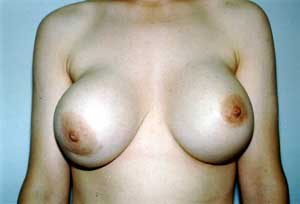
Capsular Contracture. The photograph shows grade IV capsular contracture in the right breast of a 29-year-old woman 7 years after subglandular placement of 560-cc silicone gel-filled breast implants.
Walter Peters, Public Domain, via Wikimedia Commons.
References
Van Slyke AC, Carr NJ. Reply: Not All Breast Implants Are Equal: A 13-Year Review of Implant Longevity and Reasons for Explantation. Plastic and reconstructive surgery. 2019 Mar:143(3):664e-665e. doi: 10.1097/PRS.0000000000005342. Epub [PubMed PMID: 30601311]
Shin BH, Kim BH, Kim S, Lee K, Choy YB, Heo CY. Silicone breast implant modification review: overcoming capsular contracture. Biomaterials research. 2018:22():37. doi: 10.1186/s40824-018-0147-5. Epub 2018 Dec 20 [PubMed PMID: 30598837]
Prasad K, Zhou R, Zhou R, Schuessler D, Ostrikov KK, Bazaka K. Cosmetic reconstruction in breast cancer patients: Opportunities for nanocomposite materials. Acta biomaterialia. 2019 Mar 1:86():41-65. doi: 10.1016/j.actbio.2018.12.024. Epub 2018 Dec 18 [PubMed PMID: 30576863]
Hansson E, Jepsen C, Hallberg H. Breast reconstruction with a dermal sling: a systematic review of surgical modifications. Journal of plastic surgery and hand surgery. 2019 Feb:53(1):1-13. doi: 10.1080/2000656X.2018.1533840. Epub 2018 Dec 17 [PubMed PMID: 30557054]
Level 1 (high-level) evidenceEvren S, Khoury T, Neppalli V, Cappuccino H, Hernandez-Ilizaliturri FJ, Kumar P. Breast Implant-Associated Anaplastic Large Cell Lymphoma (ALCL): A Case Report. The American journal of case reports. 2017 May 31:18():605-610 [PubMed PMID: 28559535]
Level 3 (low-level) evidence. . :(): [PubMed PMID: 31045985]
Montemurro P, Fischer S, Hager S, Hedén P. Secondary Breast Augmentation: Is There a Trend for Bigger Implants? Aesthetic plastic surgery. 2019 Feb:43(1):59-69. doi: 10.1007/s00266-018-1244-5. Epub 2018 Oct 1 [PubMed PMID: 30276457]
Chang EI, Hammond DC. Clinical Results on Innovation in Breast Implant Design. Plastic and reconstructive surgery. 2018 Oct:142(4S The Science of Breast Implants):31S-38S. doi: 10.1097/PRS.0000000000005000. Epub [PubMed PMID: 30252757]
Mohebali K, Wixtrom RN. Breast Implant Engineering and Performance. Plastic and reconstructive surgery. 2018 Oct:142(4S The Science of Breast Implants):6S-11S. doi: 10.1097/PRS.0000000000004997. Epub [PubMed PMID: 30252754]
Jewell ML, Edwards MC, Murphy DK, Schumacher A. Lactation Outcomes in More Than 3500 Women Following Primary Augmentation: 5-Year Data From the Breast Implant Follow-Up Study. Aesthetic surgery journal. 2019 Jul 12:39(8):875-883. doi: 10.1093/asj/sjy221. Epub [PubMed PMID: 30165661]
Rohrich RJ, Kaplan J, Dayan E. Silicone Implant Illness: Science versus Myth? Plastic and reconstructive surgery. 2019 Jul:144(1):98-109. doi: 10.1097/PRS.0000000000005710. Epub [PubMed PMID: 31246810]