 Tools
Tools
 Bedbug Bites
Introduction
As many as 90 species of bugs within the family Cimicidae have been identified. Bed bugs are true bugs characterized by specialized, elongated mouthparts, although few species feed on humans. The 2 species most commonly associated with human bites are Cimex lectularius and the tropical bed bug, C hemipterus. C hemipterus is typically found in tropical regions within 30° of the equator, whereas C lectularius occurs more commonly in temperate climates. However, both species have recently been reported to migrate beyond traditional geographic distributions. C lectularius is the species most commonly associated with infestations in the United States.
Bed bugs are nocturnal, blood-feeding arthropod parasites with humans as the primary host. Bed bugs typically measure 5 to 7 mm in length and have a flat, oval, reddish-brown, wingless body (see Image. Bed Bug Life Stages and Size Comparison). Survival capacity ranges from 6 to 12 months without a blood meal. Female bed bugs may lay 200 to 500 eggs during their lifetime. These characteristics facilitate rapid reproduction and infestation, with substantial colonies developing from only a few bed bugs.[1]
Bed bug infestations in the United States declined until the 1990s, when a resurgence occurred, attributed to increased international travel and the emergence of insecticide-resistant strains.[2] In 2006, Australian pest control professionals reported an increase in bed bug infestations of more than 4500%. In the United States, bed bug infestations have been reported in all 50 states. As of 2012, an estimated 1 in 5 Americans either had a bed bug infestation in their home or knew someone who had encountered bed bugs. Infestations have been reported in homes, hotels, offices, retail spaces, healthcare facilities, and cinemas. Bed bug infestations may occur in nearly any location where people sleep or remain sedentary.
Etiology
Register For Free And Read The Full Article
 Search engine and full access to all medical articles
- 10 free questions in your specialty
- Free CME/CE Activities
- Free daily question in your email
- Save favorite articles to your dashboard
- Emails offering discounts
Learn more about a Subscription to StatPearls Point-of-Care
Etiology
Bed bugs are attracted to carbon dioxide and host body heat. Contact with hosts occurs by walking from crevices in materials used as daytime harborages. Flight and jumping capabilities are absent. Humans are the preferred host, although bed bugs may feed on other warm-blooded animals. In the United States, C lectularius may infest poultry sheds and reduce egg production.
Bed bugs do not typically reside on the human body. Contact with humans occurs primarily for blood feeding every few days, when a sleeping host is available. Blood feeding typically occurs during deep sleep, most commonly between 1:00 AM and 5:00 AM.
Aggregation pheromones maintain colony cohesion, with bed bugs remaining in close contact during daylight hours while they hide and digest blood meals. These pheromones facilitate relocation to harborages after feeding.
When hosts are consistently available, the female C lectularius may lay 5 to 8 eggs per week for up to 18 weeks at 23 °C. Life cycle duration is variable and temperature-dependent at 90% relative humidity.
Human bites most commonly occur during sleep in infested beds (see Image. Bed Bugs in Mattress Ribbing). Additional furniture and furnishings within the same room may serve as harborages. Bed bugs may infest multiple human-used environments.[3]
Epidemiology
Bed bug bites occur equally in both sexes and all age groups. Increased prevalence is observed among individuals who reside in densely populated environments, such as apartment complexes, travel frequently, are exposed to hotels, or belong to lower socioeconomic brackets. Bed bug infestations may disseminate between living spaces through active migration via structural conduits, such as power outlets and air ducts. Colonies may also spread passively through transport in used furniture, luggage, and book bags. Skin-to-skin and direct clothing-to-clothing transmission are uncommon in bed bug infestations, in contrast to most other ectoparasites. Reduced transmission is attributed to nocturnal feeding behavior and avoidance of host-to-host movement.[4]
Pathophysiology
In most patients, reactions to bed bug bites result from an immunologic response to proteins present in bed bug saliva. Bed bug salivary proteins serve multiple functions, including preventing coagulation, inhibiting platelet aggregation, promoting vasodilation, and exhibiting potential antimicrobial activity. Bed bugs inject saliva through needle-like stylets inserted into the skin during feeding, with withdrawal occurring after blood feeding (see Image. Bed Bug on Human Skin). C lectularius injects nitrophorin (a vasodilator), apyrase (a platelet activation and aggregation inhibitor), and a factor X inhibitor. Papular urticaria has been associated with the presence of immunoglobulin G antibodies against C lectularius antigens. Nitrophorin has also been shown to induce allergen-specific immunoglobulin E antibodies.
Cutaneous reactions to bed bug bites follow a pattern of progressive sensitization with repeated exposure. Initial bites in previously unexposed individuals typically produce no visible reaction or a delayed response appearing approximately 8 to 10 days after the first feeding. Latency progressively shortens with subsequent exposures, ultimately resulting in immediate wheal-and-flare reactions within seconds to minutes, reflecting a transition from a primary to a secondary (memory-mediated) immune response.[5] Studies of controlled human feeding experiments have demonstrated rising immunoglobulin G levels against C lectularius salivary antigens with repeated exposures, correlating with accelerated clinical responses.[6] This sensitization timeline is clinically relevant because patients in newly infested environments may not develop visible lesions for more than 1 week, potentially delaying diagnosis.
Additionally, bed bug feces contain high concentrations of histamine, which functions as a component of the aggregation pheromone system. Infested homes have been found to contain histamine levels of 54.6 mcg/100 mg in settled house dust, compared with less than 2.5 mcg/100 mg in uninfested homes. Elevated levels may persist even after professional heat treatment.[7] Although the clinical significance of chronic environmental histamine exposure remains under investigation, it may be relevant in patients with preexisting allergic conditions.
Histopathology
Biopsy specimens from bed bug bites demonstrate edema and perivascular infiltration by lymphocytes and eosinophils. An inflammatory reaction is observed in the upper and lower dermis surrounding blood vessels and adnexal epidermal structures. Within the dermis, lymphomononuclear cells and eosinophils are present between collagen fiber bundles and in perivascular distributions. Inflammatory infiltrates within intraepidermal and subepidermal bullae contain lymphocytes, histiocytes, neutrophils, and eosinophils. Limited evidence exists regarding the temporal progression of histopathologic changes following the initial bite.
History and Physical
Bed bug bites produce variable clinical presentations. Minimal or absent cutaneous findings occur in some patients, whereas others develop large urticarial wheals exceeding 1 cm in diameter. Anaphylactic reactions have been reported but remain exceedingly rare.
Bites most commonly involve exposed skin surfaces, particularly the face, neck, and hands, although any uncovered area may be affected during sleep. Breakfast, lunch, and dinner sign is a classic hallmark finding, characterized by a linear or clustered grouping of bites, typically consisting of 3 or more lesions.[8] Proposed mechanisms include interruption of feeding or movement along the skin surface in search of a larger superficial blood vessel.
A hemorrhagic punctum at the center of the bite lesion, representing the site of stylet insertion, may be observed as an additional clinical finding that aids identification.[9] When present, this finding may help distinguish bed bug bites from other arthropod exposures. Clinicians should also recognize that the absence of cutaneous reactions among household cohabitants does not exclude bed bug infestation. Approximately 20% to 30% of exposed individuals may remain anergic and never develop visible skin findings.[10]
A recent systematic review of case reports on bed bug bites found the classic hallmark sign in less than 50% of patients, raising questions about its clinical utility. Similar bite patterns have also been described in other arthropod exposures, including kissing bugs and fleas.[11] Important historical features include the timing of lesion appearance upon waking, recent international or domestic travel, stays in hotels with high traveler turnover, and recent acquisition of used furniture or clothing from yard sales.
Cutaneous reactions do not occur in all individuals exposed to bed bug bites. A comprehensive study of infestation in the United States reported skin reactions in only 70% of affected individuals. Lower reaction rates were reported among adults older than 65 and children aged 1 to 10 (58% and 59%, respectively).
Evaluation
No standard diagnostic testing modality is currently recommended for identifying bed bug bites. Clinical suspicion of bed bug bites may arise based on typical presentation and exposure history. However, definitive confirmation requires capture and identification of a bed bug specimen. Recent studies have explored potential laboratory methods for identifying bed bug bites in cases where specimen capture is not feasible, including Western blot testing. Applications of such methods have been described in specific contexts, such as suspected exposure among international travelers following hotel stays. However, these tests are costly and available only at specialized laboratories.[12]
Several environmental detection strategies may be recommended when clinical suspicion of bed bug infestation is present. Passive interceptor traps placed beneath bed legs detected 89% of infestations in a study of low-income apartments and represent a low-cost screening method. Trained canine scent detection teams are commercially available, although field accuracy is variable, with a mean detection rate of 44% in an evaluation. Active monitoring devices using carbon dioxide or heat lures may also be used. Visual inspection remains the most accessible initial detection method, relying on recognition of fecal spots appearing as dark deposits on mattresses and bedding, along with identification of shed exoskeletons.
Treatment / Management
Reactions to bed bug bites are self-limited. Cessation of biting occurs following removal of the patient from an infested environment or eradication of the bed bug colony. Intolerable pruritic reactions warrant symptomatic treatment. The use of over-the-counter systemic antihistamines and topical antipruritic agents is often effective. Significant eruptions may require the use of low- to mid-potency topical corticosteroid preparations. Antihistamines and topical therapies provide symptomatic relief and may reduce the risk of bacterial superinfection or cellulitis secondary to excoriation.[13] Caution is warranted when prescribing corticosteroid preparations in the setting of disrupted epidermal integrity and possible infection.[14][15](B3)
The administration of oral gabapentinoids, such as gabapentin or pregabalin, may be considered as adjunctive antipruritic therapy in patients with refractory pruritus inadequately controlled with antihistamines and topical corticosteroids.[16] Secondary bacterial infection at bite sites, including impetigo, ecthyma, folliculitis, cellulitis, or lymphangitis, warrants systemic antibiotic therapy tailored to severity and suspected pathogen.
Differential Diagnosis
The differential diagnosis of bed bug bites includes flea bites, scabies, mosquito bites, skin infections, allergic reactions, miliaria, dermatitis herpetiformis, and delusions of parasitosis. Bed bug infestation should be considered in patients presenting with unexplained or undiagnosed pruritic eruptions.
Prognosis
The overall prognosis of bed bug bites is excellent. No substantial evidence suggests that C lectularius or C hemipterus serves as a vector for human pathogens. Bed bug bites have only rarely been implicated in anemia or severe allergic reactions. The most common sequelae of bed bug bites include secondary bacterial infection due to excoriation, sleep disturbance related to the itch-scratch cycle, and insomnia attributable to anxiety associated with living in an infested household.
Complications
Bed bug bites are generally considered to have no significant complications, as bed bugs do not serve as vectors for the biological transmission of pathogens. Studies have reported more severe reactions in some cases, including bullous eruptions and hypereosinophilia.[17][18] Superimposed bacterial infection, including cellulitis, may occur at sites of feeding due to disruption of the epidermal barrier from the bite itself or from excoriation secondary to scratching. Bed bug bites may also affect mental health, with reported consequences that include stigmatization, reduced self-esteem, anxiety, and psychological stress.[19]
The psychological and psychiatric consequences of bed bug infestations may be more severe than commonly appreciated. Reported sequelae include nightmares, phobias, hypervigilance, avoidance behaviors, delusions of parasitosis, posttraumatic stress disorder–like symptoms, and, in rare cases, suicidal ideation.[20] A cross-sectional study of urban residents found significantly higher odds of anxiety (odds ratio = 4.8) and sleep disturbance (odds ratio = 5.0) among bed bug–exposed individuals compared with unexposed controls.[21] A large study of approximately 5000 tenants in Montreal confirmed significantly higher odds of both anxiety and depression among individuals exposed to bed bugs.[22] These findings support active screening for psychiatric sequelae in affected patients and consideration of mental health referral when indicated.
Deterrence and Patient Education
Proper management of suspected bed bug bites requires patient education on identifying bed bug colonies, recognizing bed bugs, and selecting safe and effective extermination products or professional pest control services. Prevention of household reinfestation is a key component of bed bug bite management. Risk-reduction strategies include avoiding used furniture and inspecting hotel beds and luggage after travel.
Pearls and Other Issues
As with other arthropod infestations, caring for patients with bed bug bites may be associated with reluctance among healthcare providers to maintain physical contact. Reluctance often arises from the misconception that skin-to-skin contact facilitates transmission of bed bug infestations. Transmission requires the transfer of bed bugs from established harborages to a new environment or host. In hospital settings, infestation typically originates from colonies present in patient clothing or personal belongings. Hospital-associated infestations are generally controlled effectively through standardized linen processing protocols and removal and treatment of potentially infested bedding materials.[23]
Enhancing Healthcare Team Outcomes
Management of bed bug bites is optimally achieved through an interprofessional team approach. Clinicians provide treatment and patient education, whereas pharmacists assist in selecting over-the-counter antipruritic agents for symptom control. Case management and community resources support the coordination of environmental interventions and elimination of infestation sources within the home.
Prevention of bed bug bites is a primary management objective. Travelers should inspect hotel rooms for signs of bed bug infestation and consider alternative accommodations when an infestation is suspected. Before returning home, luggage, clothing, and footwear should be carefully inspected.
Eradication of household infestations typically requires professional pest control services. Bed bugs demonstrate resistance to many conventional insecticides, and removal of infested items, including toys and other personal belongings, may be necessary in some cases. Environmental control often requires thorough vacuuming in combination with heat-based treatments.
Unsupervised application of pesticides or insecticides in the home should be avoided due to the risk of human toxicity and limited efficacy against bed bugs. Complete eradication may require weeks to months, depending on infestation severity and environmental conditions.
Specific eradication parameters should be communicated to patients and pest control teams. Exposure to temperatures of 45 to 48 °C (113-118 °F) for 1 hour eliminates all bed bug life stages, whereas direct steaming at 60 °C achieves bed bug kill in less than 1 minute. Freezing at −20 °C (−4 °F) for at least 2 hours is also effective. Insect foggers, commonly known as bug bombs, are ineffective because aerosolized particles cannot penetrate harborage sites and may promote insecticide resistance. Notably, 100% of bed bug colonies collected in the United States between 2018 and 2019 harbored insecticide resistance gene variants, compared with 97.5% between 2005 and 2009. The average cost of professional eradication for a single-family home is approximately $1225, which presents a considerable barrier for low-income patients. This situation highlights the necessity for social work involvement and the integration of community resources in management planning.
Media
(Click Image to Enlarge)
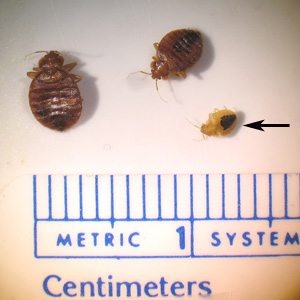
Bed Bug Life Stages and Size Comparison. This photograph shows 3 bed bugs at different stages of development positioned next to a metric ruler for scale. A black arrow highlights a smaller nymph with a visible dark blood meal in its abdomen, located next to 2 larger adult bed bugs.
Public Health Image Library, Public Domain, Centers for Disease Control and Prevention
(Click Image to Enlarge)
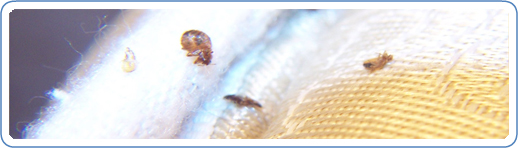
Bed Bugs in Mattress Ribbing. This close-up photograph shows bed bugs harboring within the seams and ribbing of a mattress fabric. The image captures multiple life stages, including an adult insect and debris tucked into the structural folds.
Public Health Image Library, Public Domain, Centers for Disease Control and Prevention
(Click Image to Enlarge)
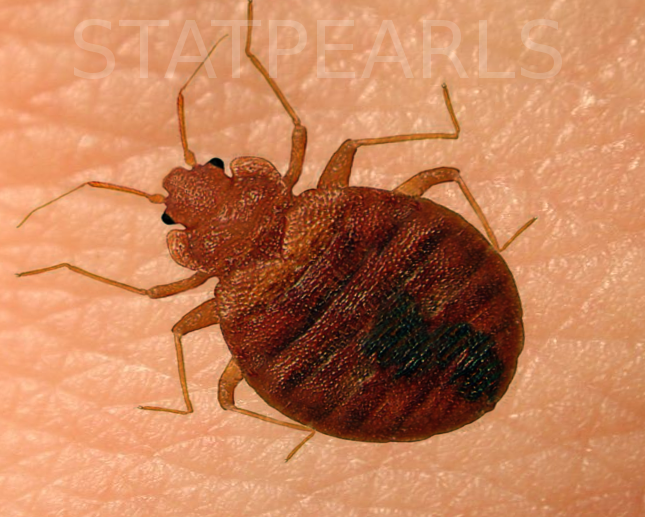
Bed Bug on Human Skin. This high-magnification photograph shows an adult bed bug crawling across the surface of human skin. The insect features a characteristically flattened, reddish-brown body with distinct abdominal segments.
Contributed by S Bhimji, MD
References
Carbone G, De Bona A, Septelici D, Cipri A, Nobilio A, Esposito S. Beyond Mosquitoes: A Review of Pediatric Vector-Borne Diseases Excluding Malaria and Arboviral Infections. Pathogens (Basel, Switzerland). 2025 Jun 2:14(6):. doi: 10.3390/pathogens14060553. Epub 2025 Jun 2 [PubMed PMID: 40559561]
Kolb A, Needham GR, Neyman KM, High WA. Bedbugs. Dermatologic therapy. 2009 Jul-Aug:22(4):347-52. doi: 10.1111/j.1529-8019.2009.01246.x. Epub [PubMed PMID: 19580578]
Level 3 (low-level) evidenceDoggett SL, Dwyer DE, Peñas PF, Russell RC. Bed bugs: clinical relevance and control options. Clinical microbiology reviews. 2012 Jan:25(1):164-92. doi: 10.1128/CMR.05015-11. Epub [PubMed PMID: 22232375]
Level 3 (low-level) evidenceIbrahim O, Syed UM, Tomecki KJ. Bedbugs: Helping your patient through an infestation. Cleveland Clinic journal of medicine. 2017 Mar:84(3):207-211. doi: 10.3949/ccjm.84a.15024. Epub [PubMed PMID: 28322676]
Sheele JM, Ridge GE, Coppolino K, Bonfield T, Young AB, Gaines SL, McCormick TS. Antibody and cytokine levels in humans fed on by the common bedbug, Cimex lectularius L. Parasite immunology. 2017 Mar:39(3):. doi: 10.1111/pim.12411. Epub [PubMed PMID: 28075502]
Sheele JM, Ferrari B, Goddard J, Schlatzer D, Lundberg KC, Guinto K, Embers ME, Young AB, Ridge GE, Damiani G, McCormick TS. Human immunoglobulin G responses to Cimex lectularius L. saliva. Parasite immunology. 2020 Dec:42(12):e12764. doi: 10.1111/pim.12764. Epub 2020 Jun 22 [PubMed PMID: 32516446]
Sheele JM. Association between bed bugs and allergic reactions. Parasite immunology. 2021 Jul:43(7):e12832. doi: 10.1111/pim.12832. Epub 2021 Mar 25 [PubMed PMID: 33704797]
Peres G, Yugar LBT, Haddad Junior V. Breakfast, lunch, and dinner sign: a hallmark of flea and bedbug bites. Anais brasileiros de dermatologia. 2018 Sep-Oct:93(5):759-760. doi: 10.1590/abd1806-4841.20187384. Epub [PubMed PMID: 30156636]
Parola P, Izri A. Bedbugs. The New England journal of medicine. 2020 Jun 4:382(23):2230-2237. doi: 10.1056/NEJMcp1905840. Epub [PubMed PMID: 32492304]
Thomas C, Castillo Valladares H, Berger TG, Chang AY. Scabies, Bedbug, and Body Lice Infestations: A Review. JAMA. 2024 Sep 9:():. doi: 10.1001/jama.2024.13896. Epub 2024 Sep 9 [PubMed PMID: 39250129]
Porras-Villamil JF, DeVries ZC. Clinical manifestations of bed bug bites: A systematic review of case reports. PloS one. 2026:21(4):e0341398. doi: 10.1371/journal.pone.0341398. Epub 2026 Apr 29 [PubMed PMID: 42054290]
Level 1 (high-level) evidenceGoddard J, Tardo AC, Embers ME. Western Blotting of Human Sera-Can It Help Diagnose Bed Bug Bites? Skinmed. 2015:13(5):345-6 [PubMed PMID: 26790502]
Studdiford JS, Conniff KM, Trayes KP, Tully AS. Bedbug infestation. American family physician. 2012 Oct 1:86(7):653-8 [PubMed PMID: 23062093]
Level 3 (low-level) evidenceChittoor J, Wilkison BD, McNally BW. What's eating you? bedbugs. Cutis. 2019 Jan:103(1):31-33 [PubMed PMID: 30758341]
Huntington MK, Allison JR, Hogue AL, Shafer CW. Infectious Disease: Bedbugs, Lice, and Mites. FP essentials. 2019 Jan:476():18-24 [PubMed PMID: 30615406]
Ottu Para NK, Rab S. Arthropod Exposure-Associated Neurogenic Pruritus: A Complex Neuro-Immune Transition Mimicking Refractory Urticaria. Cureus. 2026 Apr:18(4):e107918. doi: 10.7759/cureus.107918. Epub 2026 Apr 28 [PubMed PMID: 42220678]
deShazo RD, Feldlaufer MF, Mihm MC Jr, Goddard J. Bullous reactions to bedbug bites reflect cutaneous vasculitis. The American journal of medicine. 2012 Jul:125(7):688-94. doi: 10.1016/j.amjmed.2011.11.020. Epub 2012 May 4 [PubMed PMID: 22560811]
Level 3 (low-level) evidenceWeitzel IB, Palma V, Silva M, Castro A, Weitzel T. Systemic illness with eosinophilia and urticaria-like rash caused by prolonged bedbug exposure. International journal of infectious diseases : IJID : official publication of the International Society for Infectious Diseases. 2025 Oct:159():107991. doi: 10.1016/j.ijid.2025.107991. Epub 2025 Jul 20 [PubMed PMID: 40695419]
Leung AKC, Lam JM, Barankin B, Leong KF, Hon KL. Bed Bug Infestation: An Updated Review. Current pediatric reviews. 2024:20(2):137-149. doi: 10.2174/1573396320666230406084801. Epub [PubMed PMID: 37038684]
Goddard J, de Shazo R. Psychological effects of bed bug attacks (Cimex lectularius L.). The American journal of medicine. 2012 Jan:125(1):101-3. doi: 10.1016/j.amjmed.2011.08.010. Epub [PubMed PMID: 22195533]
Susser SR, Perron S, Fournier M, Jacques L, Denis G, Tessier F, Roberge P. Mental health effects from urban bed bug infestation (Cimex lectularius L.): a cross-sectional study. BMJ open. 2012:2(5):. doi: 10.1136/bmjopen-2012-000838. Epub 2012 Sep 25 [PubMed PMID: 23015597]
Level 2 (mid-level) evidenceRiva M, Kaiser D, Dufresne P, Plante C. Bed bug infestations: prevalence, correlates, and cross-sectional association with psychological symptoms in a large sample of tenants in Montreal, Canada. BMC public health. 2025 Dec 20:26(1):318. doi: 10.1186/s12889-025-25936-7. Epub 2025 Dec 20 [PubMed PMID: 41419846]
Level 2 (mid-level) evidenceWilliams J. Bed bugs in hospitals: more than just a nuisance. CMAJ : Canadian Medical Association journal = journal de l'Association medicale canadienne. 2013 Aug 6:185(11):E524. doi: 10.1503/cmaj.109-4491. Epub 2013 Jun 17 [PubMed PMID: 23775615]
Level 3 (low-level) evidence