 Tools
Tools
 Financing And Funding A Simulation Center
Introduction
Simulation has become an integral component of modern medical education. As healthcare simulation has become a mainstream educational modality for adult learners, simulation centers face the challenge of financial sustainability. Simulation centers and simulation-based training programs can be costly to build and maintain and require substantial long-term investment from their affiliated organization(s). While simulation has been shown to improve patient outcomes, funding for training and education is finite, and understanding and justifying these costs can be challenging.[1][2] Clearly articulating the costs and the clinical and economic benefits of a simulation-based training program provides the organization with the data needed to support its decision to invest in such training.[3]
Function
Register For Free And Read The Full Article
 Search engine and full access to all medical articles
- 10 free questions in your specialty
- Free CME/CE Activities
- Free daily question in your email
- Save favorite articles to your dashboard
- Emails offering discounts
Learn more about a Subscription to StatPearls Point-of-Care
Function
Costs
Costs associated with the deployment and operation of a simulation center often are broadly summarized as “stuff, staff, and space.” Direct costs are typically the first to come to mind when considering the cost of a simulation program. Initial costs such as the design and engineering of the space, the actual materials and construction costs to build the space, and the acquisition of computers, software, mannequins, stretchers, and consumables would be considered direct costs. Salaries considered direct costs are those that directly support a program, including faculty stipends, standardized patients, and simulation operations specialists for educational events.[4][5]
Indirect costs include operational overhead, such as administrative support and salaries, utilities, insurance, and depreciation of buildings and facilities. Items such as office supplies and consumables not directly invoiced to learner groups would also fall into this category. Some indirect costs unique to the simulation include equipment and simulator use, simulator warranties, and equipment repair. Salaries typically considered indirect costs vary with the center's scale and needs and may include a director's stipend, administrative assistants, security personnel, custodians, education specialists, and research support staff.
Another way to assess cost when operationalizing a simulation program is to account for opportunity costs. These are the “lost opportunities,” when resources or time could be used elsewhere, such as the time a clinician-educator spends outside of clinical practice or the operating room, or the revenue that could be generated from using the simulation center space for other activities.
All of these should be considered when developing the center's annual cost cycle and can also be applied to individual educational programs. An annual cost cycle should be calculated to ensure the simulation center's sustainability. Numerous economic evaluations demonstrate the effectiveness of the dollars spent. A full economic evaluation is used when 2 or more alternatives are considered, and both outcomes and cost data are available. When complete information is unavailable or alternatives are limited, a partial evaluation can be used. This partial evaluation would look at either outcomes or costs.
Common Cost Examples
Staff
Full-time staff cost (Sim Ops), Standardized Patients, and expert instructors are the most common direct staff expenses. Other considerations when hiring clinical staff include ongoing professional development and replacing expert-instructor clinical time. There are substantial personnel costs associated with running a successful, high-quality simulation that must be considered up front. Smaller simulation programs may consider outsourcing personnel to remain cost-effective.
Stuff
High fidelity simulation requires the “stuff” to be in good working order for all learners. High costs are incurred when acquiring new equipment, including ultrasound machines, task trainers, radiology equipment, computers, video monitors, network infrastructure, and software. It is also important to recognize associated recurring costs, such as maintenance, consumables, and recycling supplies for other purposes. When purchasing large items such as mannequins and task trainers, it is also important to consider the warranty and expected lifespan. All of these factors help determine the supply cost for a given course. This information can then be used in the financial analysis discussed above. If cadavers are implemented in the +simulation, additional laws must be considered. Donated tissue is not used to generate profit; however, storage and handling fees are acceptable.
Space
The discussion of space depends heavily on the institution's needs and budget. Space for a simulation can be provided by an institution, rented, or purchased. The cost range cannot be generalized, but the most consistent items are cost per square foot, maintenance, and associated utilities. Standard utilities such as electricity are a consideration, but it is also important to factor in medical utilities, including medical gas, large-unit refrigeration, and negative-pressure systems.
Cost Cycle Example
An annual Cost Cycle includes a comprehensive evaluation of the simulation center. For a simple example, consider the cost cycle for a simulation center that delivers 1 central line course per month to a group of 10 learners. For this example, our simulation space is 200 sq ft, 1 simulation operations specialist, 1 clinical education specialist, 10 learners, 1 reusable mannequin, and 10 disposable pieces.
Direct Costs be identified first. For this example, they include Simulation Employee Salary, Reusable Mannequin, and Disposable Kits. In our example, the employee is paid $40k annually, the mannequin costs $ 5,000, and the central line kits cost $50. For this example, the mannequin has a useful life of 5 years, and the simulation space has been paid for.
In this example, the indirect costs are the clinical time lost by the subject matter expert/clinician-educator, rent for the simulation space, maintenance of the simulation space, and utilities for the simulation space. Qualitative indirect costs, such as educators' lost clinical time, can be quantified using several methods. One simple method is to take a full-time clinician's annual salary and calculate the lost income based on hours. For our example, let’s assume that a course takes 4 hours a month to run. Over the course of a year, our expert clinician gives up 48 hours of clinical time to teach. If he worked 160 hours per month, he would be giving up 2.5% of his clinical time (4/160). A full-time clinician may otherwise make $250,000 per year. Since he is giving up 2.5% of his time, the opportunity cost for this physician educator is $6,250 (0.025 × $250,000).
The table outlines the total cost of this 1 class annually (see Image. Cost Analysis Example). This rudimentary cost cycle identified a total annual cost of $64,050 to provide a central line course to 10 learners per month. Dividing the annual cost by 12 yields a monthly cost of $5,337.50. Since this example has 1 course per month with 10 learners, the total cost per learner is $533.75. This information can then be used for strategic planning moving forward.
The information contained in an annual cost cycle can be as detailed as needed for a given center. A cost analysis can be conducted for any subcategory and evaluated on a course-by-course or even instructor-by-instructor basis. This information can help predict next year's expenses if there are significant differences in the costs and resources used by different instructors.
Revenue
Funding a simulation center is a complex endeavor. Funding can be viewed as 2 components: initial investment and ongoing revenue. When analyzing revenue streams, it is also important to account for the difference between projected and actual revenue. Well-functioning simulation centers benefit from diverse revenue streams to ensure financial sustainability. When developing a strategic plan for a simulation center, it is crucial to identify both internal and external revenue streams. Having diverse revenue streams improves a center's sustainability.[6]
Internal Streams
Institution-based simulation centers benefit from having multiple stakeholders to ensure the center's success and sustainability. It is important to balance the use of simulation training within an institution with the direct and opportunity costs of doing business externally. Internal revenue streams come in many forms. A simulation center can offer a 1-time cost to the university, based on the course, and charge departments for use. Some centers operate on a hybrid model, offering courses to the university at cost or close to cost, and diversifying revenue streams by charging an alternative industry rate to private consumers. Some centers may be fortunate to have donors. Depending on the scale of the donor pool, a center may have an endowment. A center may be partially or completely funded by an endowment. This endowment may have constraints on how funding can be spent when dealing with internal vs external stakeholders.
External Streams
Simulation centers offer several opportunities in the private sector. A given center can partner with a local private industry partner, such as a medical device manufacturer, to deliver classes using high-fidelity simulation. There are opportunities to contract with external hospital systems, such as private hospitals or EMS. Educational courses are another potential revenue stream and can be offered regionally.
Grants
Innovative simulation centers can be opportunities for several educational funds, from grants for simulation research. Private grants from donors create opportunities for revenue and to expand the simulation center brand.
Cost savings
Although difficult to appreciate in the beginning stages of simulation center development and planning, cost savings are important when determining return on investment. Examples of cost savings that can result from implementing simulation training include reductions in malpractice insurance rates, lower lost revenue from catheter-associated urinary tract infections or central line-associated bloodstream infections, and broader cost savings from reduced medical errors (length of stay, infection rates, adverse events).
Directly, consumable and other large purchase costs can be mitigated through bulk purchasing when available. During annual reviews, it is important to identify opportunities for high-utilization components and opportunities for bulk discounts. Working in tandem with a hospital or institution may help reduce the cost per consumable item.
Burril, S, Kane, A. Deloitte 2017 survey of US health system CEOs: Moving forward in an uncertain environment. Deloitte Center for Health Solutions. (2017)
Return on Investment
When assessing return on investment, the literature identifies 3 components to evaluate the value of simulation training. As demonstrated above, it can be difficult to recognize the value of simulation training because it involves several intangible assets. A model to determine the return on investment of simulation training was developed to address these unique challenges. (Bukhari et al) The components described are costs, qualitative benefits, and quantitative benefits.[3][7]
Cost
As mentioned above, costs include development, maintenance, operations, labor, and materials.
Quantitative Benefits
Generally, quantitative benefits are easier to measure. Quantitative benefits include time savings, error reduction, time to competence, equipment breakage costs, reduced alternative training, and fewer procedures performed. These factors were described by Frost & Sullivan and incorporated into an ROI tool specifically designed to calculate ROI for computer-based simulations.
Qualitative Benefits
When calculating return on investment, measuring qualitative benefits is often the most difficult to monetize. The work of Phillips and Phillips presents a framework for estimating the effectiveness of training programs. In simulation, this framework supports the expansion or continuation of a given training program. Their framework is dependent on feedback from participants themselves and functions on the assumption that “participants are capable of determining how much improvement is related to the actual training program.”
Once these components are identified, the ROI framework begins with the value measurement methodology (VMM). This methodology was developed by the Office of Social Security to identify the qualitative and quantitative effects of regulations. A blueprint was published in 2002, enabling the VMM framework to be applied to various projects. For the purposes of simulation, Bukhari et al described the following 5 value categories:
- Direct value—benefit of simulation in training users (eg, PGY1 trainees)
- Social value—the benefit to society (eg, quality of care, fewer complications)
- Operational value—decrease in length of stay
- Strategic value—patient safety culture, sustainability
- Financial value—increase revenue, reduce costs.
In some cases, a program may generate no revenue but still align with the center's strategic plan or provide a marketing opportunity.
It is also important to keep the center's mission statement in mind when considering new revenue streams.
Phillips JJ, Phillips PP. Show Me the Money: How to Determine ROI in People, Projects, and Programs. 1st ed. San Francisco, CA: Berrett-Koehler Publishers; 2007.
Barriers to Sustainability
Designing, constructing, and maintaining can be expensive. Once a simulation center is operational and costs and funding are identified, the next step is to focus on sustainability. As a simulation center grows, it adds pressure to remain cost-neutral for the organization and to justify existing costs. One common barrier is determining which users and events to prioritize. For institution-based simulation centers, a diverse learner base translates into a diverse revenue stream, which may benefit the center's bottom line. On the other hand, adding external revenue streams may conflict with internal stakeholders' use of the space. The decision to prioritize an external stakeholder over an internal one should be based on careful analysis of the situation. Another common pitfall early in planning is underestimating indirect costs. Underestimating indirect costs can lead to significant budget issues moving forward, especially when confronted with unexpected losses. This underscores the critical importance of a thorough, well-planned cost cycle. It is also important to consult with other simulation center leaders to ensure accurate representation of estimated indirect costs, especially in the early stages of a simulation center's development.[8][9]
Another barrier often overlooked is competition. When a center is built, it may be the only 1 offering educational experiences in a region or in a particular type of educational experience. To stay competitive, a center must balance operating costs with the broader market cost of the services provided. Even if there are no similar offerings for simulation-based training in a given region, there is a point at which external organizations find it more cost-effective to bring certain components of service or simulation in-house. Once another organization has the resources to train in-house, it may begin offering that training to the broader community, thus increasing the competition in that region.
The final anticipated barrier to consider is technology costs. As new technology emerges, it may enhance the simulation experience, which clients and directors alike demand. Ongoing purchases of new technology incur significant startup costs. This cost includes the technology itself, staff training, implementation, potential ancillary technologies to augment the experience, and downtime in areas of the center while the new technologies are installed and tested. Implementing new technologies must be guided by a broad strategy. Some questions to consider: Does this new technology improve learning? Can I justify the increased cost-per-use to my clients? Will this technology significantly improve in the near future?
While this short list covers some barriers to sustainability, it is important to be aware of the unanticipated. For example, a hospital-funded simulation center may experience budget cuts from its parent organization for a myriad of reasons. If the simulation center lacks diversity in its funding, it cannot sustain itself if the larger parent organization reduces funding. This is an important concept for both institution-dependent and institution-independent centers. A loss of a revenue stream can occur at any center. A single revenue stream center exposes significant liability in bearish economic times or when that single funding source is strained.
Clinical Significance
Simulation is a complex and growing field that educates healthcare providers at all levels and student learners. Understanding the fundamentals of a financially sustainable simulation program is critical to its long-term success.
Enhancing Healthcare Team Outcomes
Typically, an interprofessional team approach comprising clinicians, nurses, and business administrators is required to secure financing for the development of a simulation learning center.
Media
(Click Image to Enlarge)
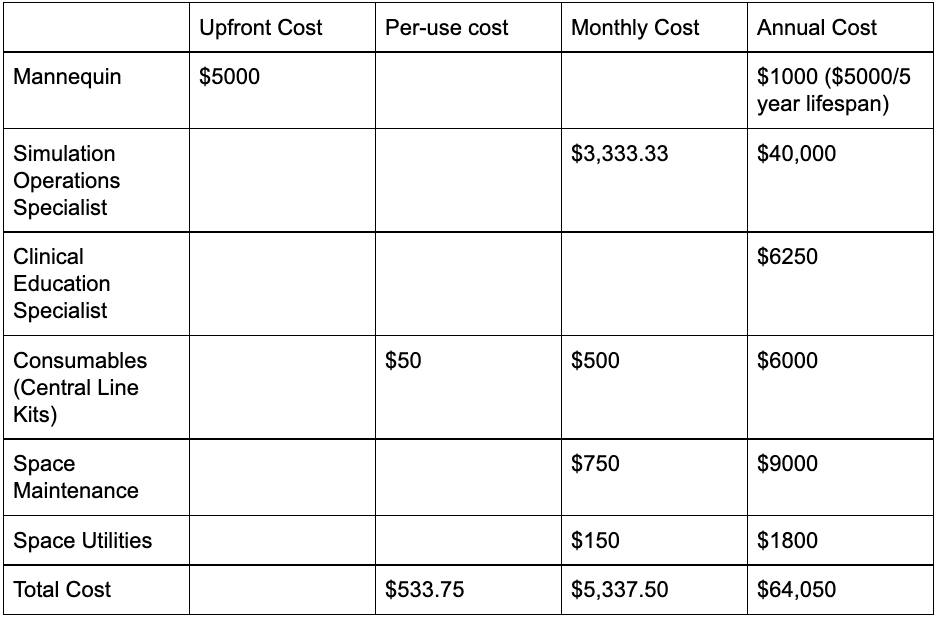
Cost Analysis Example
Contributed by J Senvisky, MD
References
Murphy M, Curtis K, McCloughen A. What is the impact of multidisciplinary team simulation training on team performance and efficiency of patient care? An integrative review. Australasian emergency nursing journal : AENJ. 2016 Feb:19(1):44-53. doi: 10.1016/j.aenj.2015.10.001. Epub 2015 Nov 21 [PubMed PMID: 26614537]
Okuda Y, Bryson EO, DeMaria S Jr, Jacobson L, Quinones J, Shen B, Levine AI. The utility of simulation in medical education: what is the evidence? The Mount Sinai journal of medicine, New York. 2009 Aug:76(4):330-43. doi: 10.1002/msj.20127. Epub [PubMed PMID: 19642147]
Asche CV, Kim M, Brown A, Golden A, Laack TA, Rosario J, Strother C, Totten VY, Okuda Y. Communicating Value in Simulation: Cost-Benefit Analysis and Return on Investment. Academic emergency medicine : official journal of the Society for Academic Emergency Medicine. 2018 Feb:25(2):230-237. doi: 10.1111/acem.13327. Epub 2017 Nov 30 [PubMed PMID: 28965366]
Maloney S, Haines T. Issues of cost-benefit and cost-effectiveness for simulation in health professions education. Advances in simulation (London, England). 2016:1():13. doi: 10.1186/s41077-016-0020-3. Epub 2016 May 17 [PubMed PMID: 29449982]
Fletcher JD, Wind AP. Cost considerations in using simulations for medical training. Military medicine. 2013 Oct:178(10 Suppl):37-46. doi: 10.7205/MILMED-D-13-00258. Epub [PubMed PMID: 24084304]
Fahey P, Cruz-Huffmaster D, Blincoe T, Welter C, Welker MJ. Analysis of downstream revenue to an academic medical center from a primary care network. Academic medicine : journal of the Association of American Medical Colleges. 2006 Aug:81(8):702-7 [PubMed PMID: 16868422]
Bukhari H, Andreatta P, Goldiez B, Rabelo L. A Framework for Determining the Return on Investment of Simulation-Based Training in Health Care. Inquiry : a journal of medical care organization, provision and financing. 2017 Jan:54():46958016687176. doi: 10.1177/0046958016687176. Epub [PubMed PMID: 28133988]
Hailemariam M, Bustos T, Montgomery B, Barajas R, Evans LB, Drahota A. Evidence-based intervention sustainability strategies: a systematic review. Implementation science : IS. 2019 Jun 6:14(1):57. doi: 10.1186/s13012-019-0910-6. Epub 2019 Jun 6 [PubMed PMID: 31171004]
Level 1 (high-level) evidenceQayumi K, Pachev G, Zheng B, Ziv A, Koval V, Badiei S, Cheng A. Status of simulation in health care education: an international survey. Advances in medical education and practice. 2014:5():457-67. doi: 10.2147/AMEP.S65451. Epub 2014 Nov 28 [PubMed PMID: 25489254]
Level 3 (low-level) evidence